Showing posts with label poems. Show all posts

Tuesday, 3 June 2014

Keeping up with Comments

I've been having problems with my comments page just like I had a few months ago.  Here are a couple of them - which I could not deal with earlier.


Thank you Anon at 10.53am.  Racial and religious differences will always matter for all of us, not only in Malaysia.  If we look at the example of Northern Ireland  ( a part of the United Kingdom), where there is hardly any difference in colour and culture in the Northern Irish, the religious animosity between the two dominant Christian factions - the Catholics and the Protestants - remains as intransigent as ever, despite the Peace Treaty and the political transformation that followed.

As for racial and religious differences, if we look at what happened in many other countries (South Africa, Sri Lanka and Burma for example) the inherently and historically Malay-Muslim Peninsula has a lot to be proud of.  Despite being flooded with immigrants whose religion and race and culture are as far apart as chalk and cheese, Semenanjung Tanah Melayu has done a commendable job (albeit with a couple of warts) in sustaining  all who live on board, in sharing the country's largesse and even giving room for one immigrant group to maintain and develop their economic prowess and control.  Of course , the less privileged and the poorer denizens have to be given a leg-up, despite the complaints and whingeing of the well-heeled who believe that they got to be where they were and are,  primarily on merit.

The table below illustrates the reduction of the gap between rich and poor which, since Colonial times, has coincided with a racial overlay and an urban/rural divide.


Here's a closeup of the above Table:  Mean Monthly Gross Household Income by Ethnicity, Strata and State, Malaysia, 1970-2012.


In short this Government has done quite well, for a Third World Country - and a Government run by mainly  Malay-Muslims to boot!!


As for your second sentence, I detect a bit of snide and insinuation about referring to West Malaysia as  "The Malay Peninsula".  Whether the Malay Peninsula is now West Malaysia or Peninsular Malaysia or Semenanjung Malaysia - in the language of the Malays from the Malay Archipelago-  before the encroachment of the Portuguese, the Dutch and the British and the unnatural increase of the Semenanjung's population - the Peninsula  consisted of several  Malay-Muslim states:
1. The Kedah Sultanate which included Penang and Seberang Prai  (1136 to the present)
2. The Malacca Sultanate  (1462-1511)
3. The Johor Sultanate which included Singapore  (1528 to the present) ......

...... and the Sultanates of Pahang, Kelantan, Perlis, Perak, Selangor, Negri Sembilan and Trengganu.

As for Borneo, up to the arrival of the Europeans, the two major powers were the Brunei and Sulu Sultanates.  But that's another story of  Judaeo-Christian malfeasance in Southeast Asia.  They did the same when they carved up the African continent among themselves.  The violent mess that plagues the Middle East had its origin in the (secret) 1916 Sykes-Picot Agreement between United Kingdom, France and pre-Revolution Russia to divide the Arab provinces of the defeated Ottoman Empire.

The name of  a  nation can be changed, it can even be anglicized, but the core makeup of its entity remains intact despite attempts by certain parties to rescript its history.

"Those who do not remember the past are condemned to relive it."   (George Santayana 1863-1952)

                                                          ------------------------


Thank you Anon May 21 2014 at 4.05 am.

I don't think the Malay Sultans have the same privileges as royalty elsewhere.  The Crown Prince of the United Kingdom can spout statements about how Muslims are making life difficult for Christians in the Middle East and he can blithely compare Putin to Hitler AND he can get away with it.

Why name only Pertubuhan Melayu Kebangsaan Melayu Bersatu  (I assume you mean UMNO)?  What about PKR and PAS?

As for your suggestion that AsH should write an open letter to the "party president and the Sultan",  it reminded me of  another occasion when my fellow-Malays asked me to be their  'representative'.

In Singapore, in the late 1960s,  the celebration for Hari Raya Puasa depended on the sighting of the moon.  There were times when this did not coincide with the official date for Hari Raya.  When that happened, teachers and students of Sekolah Menengah Yusof Ishak were only allowed time off for prayers and then they had to report for school as usual.  That was when the Malay teachers, mostly men, both senior and junior pushed me forward to ask the principal, Mr Charles Lazaroo to give the Malay medium staff and students time off for the rest of the day after prayers.  I was just in my early 20s and I found no difficulty in chiding them and suggested ,  "Why don't all of us talk to Mr Lazaroo?"  That stopped all the proposals and pleas to place me in the line of fire.

This, I fear is the most destructive weakness of the orang Melayu - they are too self-serving and hence become too divided to take a stand.  They prefer to shine in the light of the opposition groupings by sucking up to them and to contribute to slagging off their fellow Malays  than to take on the taunts and  fire from their own  kin-groups and from their nemesis.

Furthermore, unlike me, your generation has a longer time left on this earth to make the necessary changes and sacrifice to guide the "frustrated and pragmatic Malays"out there - whether at home or abroad.   AsH is getting too old and weary from fighting too many battles for her students - being a minder for the Malay Stream against the English Stream in YISS  and for the English Stream vis-a-vis the Chinese Stream in Jurong Secondary School.

In my seventh decade, I  do not have the energy to pitch any more battles.  All I do is react- to hypocrisy and double standards - to convey a tit-for-tat and  turn myself into ....

Drawn by my Voodoo-man,  Iain Buchanan
  
Let me quote one of  our sharpest and kindest Malay poets and gentlemen, Usman Awang.  Where are the likes of him today??

Extracted from Zaini Hassan, Dilema Melayu Moden  (pages 373-376)
                                                  ----------------------------------------------


Thank you very much cannonkapit for the bouquet.

It's very touching, your belief in what I write.  Cikgu has never left her 'tanah air'  (which includes Singapore and  Malaysia), wherever she settles.  Right now, since 2007, the spouse and I have the best of our two worlds that we hold close to our hearts - Malaysia and  England. 


                                                    --------------------------------


 Thank you Leicester United Fan,

Even though our LFC did not make it big, but as a fan you've done quite well.  I can't agree more with what you've said.  The election results have proven what we all knew all along.  She was used for a patsy by her two Sifus -   the father and the son ... and Diana the Roman goddess of the hunt, the moon and birthing!


Monday, 13 May 2013

Let my country awake.

In January 1975, I came back to resume my studies at London University.  My father passed away in December 1974 and I had gone back home for over a month to be with the family.

When I went for my lecture, my lecturer Lady Rosemary Firth glared at me and angrily asked  "Where have you been?"

I broke down and cried and uttered  " My father died.  I went home."  I wasn't angry with her.  It was because she cared.

When class was over, she took me by the arm and said,  "Come with me."  We went to her room and she  told me how she dealt with the loss of her father. She wore black!

She had been in Trengganu for some time where her husband researched and wrote the book  " Malay Fishermen :  Their Peasant Economy, 1946 ".  She told me she was aware of how Malays, as Muslims, dealt with bereavement.   But as I was alone in London, she wanted me to see the University's counsellor.  It was my choice.

She further added,  "Come and see me when ever you feel like it".   In fact she invited me to her house at Highgate and for me , that was one of the kindest and enriching visits in my life.  There I learned from her about "Wayang Kulit" .  They had been  presented with the whole set of puppets and she reassured me they have all been  'de- spiritualised'.  She understood the reasons why this had to be done and I think somewhere in her she also believed in the spirit of the need to do so.

So I went to the University Clinic at Malet Street, to see the psychologist/psychotherapist .   It helped me tremendously.  After about five sessions I thanked the doctor  ( I've forgotten his name) and told him that I  did not "need him any more".   He smiled and said  " Good, remember my door is always open".

That's a long preamble for what I actually wanted to post.  My father, up to his death,  kept up a correspondence with me about what was going on in the Federation ( his way of referring to his tanah air) in the 1970s and how he was concerned about what was happening to the Malays.

When I saw this poem  at the University Clinic, I thought about my father and his love for his homeland.

And now, when I receive comments from my readers about their sadness and despair over what's happening in their motherland , I recall Rabindranath Tagore's  Let My Country Awake.

Where the mind is without fear and the head held high;
Where knowledge is free;
Where the world has not been broken up into fragments by narrow domestic walls;
Where words come out from the depth of truth;
Where tireless striving stretches its arms towards perfection;
Where the clear stream of reason has not lost its way into the dreary desert sand of dead habit;
Where the mind is led forward by Thee into ever-widening thought and action;
Into that heaven of freedom, my Father, let my country awake.

Rabindranath Tagore  (1861-1941)


Sunday, 3 March 2013

A DIGRESSION

Three days ago I discovered more old books in the back-shed.  I think this house has to be fumigated - against all sorts of ancient things, including the two inhabitants.

This is the piece de resistance  :

It's a cloth bound PELITA BAHASA MELAYU by Za'ba from 1954 - though it's damaged from weathering and from being munched by moths and silver fish.  I love it for the "e-tanda" script, and for the last paragraph of the Introduction.

This illustrates so well the humility of the man and the scholar - and especially the gracefulness of his expression.

But here is the source of my digression.  I found this book ........


......... and this poem.

A  CLOCK  TALE

White Bird! White Bird!  Why are you so thin?
Of course I am thin.  For the fish won't rise.
Fish! Fish! Why won't you rise?
How can I rise when the grass on the bank is so long?
Grass! Grass!  Why are you so long?
Of course I am long.  For the cows won't eat me.
Cow! Cow!  Eat the grass!
How can i eat it, when my stomach aches?
Stomach! Stomach!  Why do you ache?
Because the rice is not cooked.
Rice! Rice! Why aren't you cooked?
Because the wood for the fire is wet.
Fire-wood! Fire-wood!  Why are you wet?
I am wet because of the rain.
Rain! Rain!  Why do you wet the wood for the fire?
Of course I wet it, when frog calls for me.
Frog! Frog!  Why do you call for the rain?
Because a snake wants to eat me.
Snake! Snake!  Why do you want to eat poor frog?
Because he is my proper food.


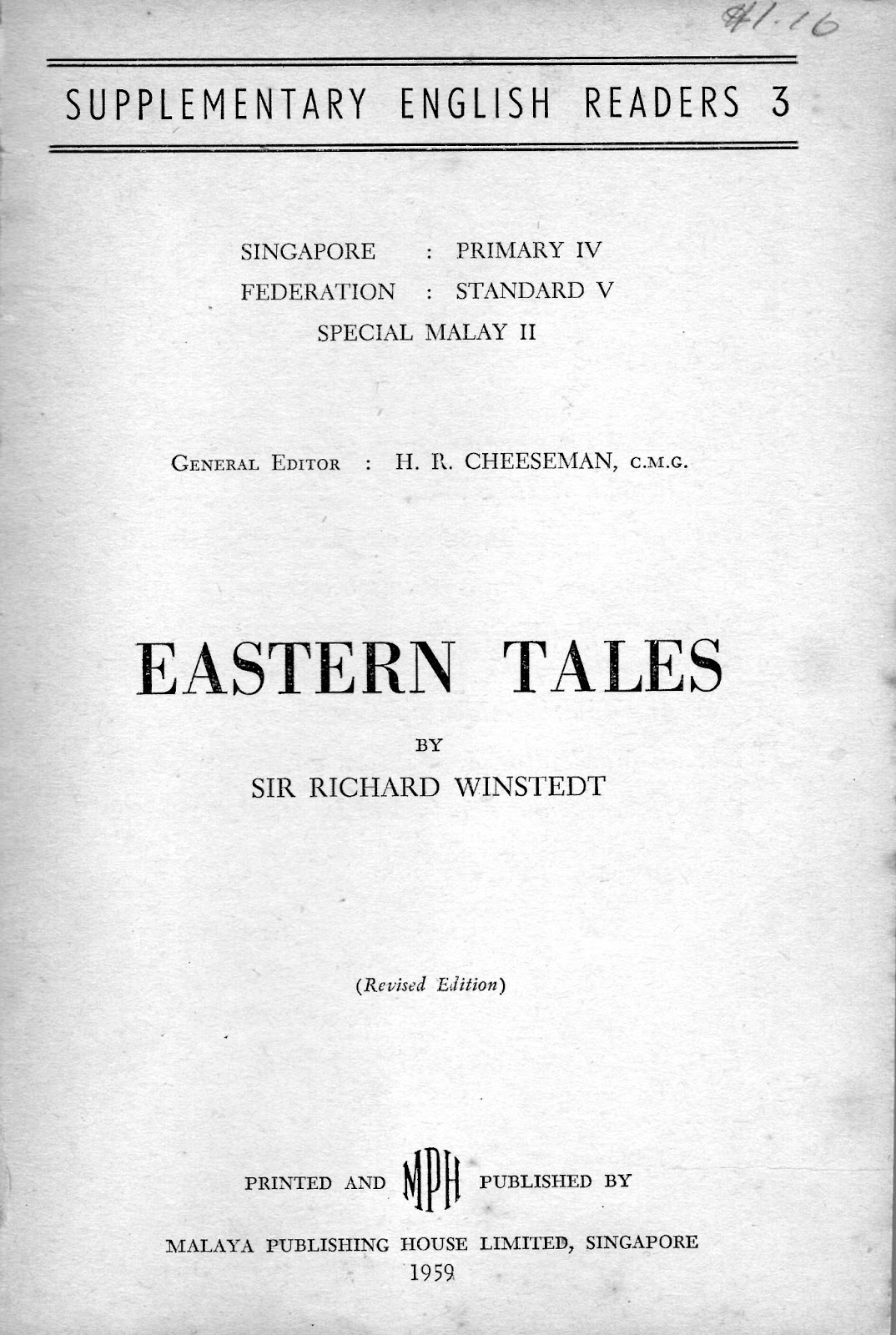
This was Winstedt's translation of the original Malay poem for children that we all treasure and love.


It's a catchy, lively poem and song with a distinct galloping rhythm.  The words are simple and the familiar and homely imagery are of a riverside world, of farmers and fishermen.

It is made for dramatisation and allows for a large cast of participants - ideal for a classroom.  If only we could know who the writer is.  But this is typical of our traditional Malay poets, pantun writers and composers of   "lagu lagu Melayu Asli" .  Their names and fame were inconsequential to them.  Ownership, patents and copyrights were not part of their world.

But as in most traditional songs and poems, there is always a moral and a lesson tucked away in the lines.  We can simply absorb them as a happy ditty or discover important depths and meaning in the allegory. At one level this song could be about the food chain and the cycle of  life.  At its most basic it could refer to the food chain in a grassland environment where the animals at the top rarely become a meal for any other animal.  For example, humans, eagles and lions belong to this category. Below them are the snakes and they gobble up the mice.  Mice are at the bottom and they consume the plants and grains.  These last are considered as the producers because they make their own food by photosynthesis.

But I somehow don't think the writer of this song had such a structure in mind  -  about a natural order of consumption and survival.

At every level, our animal cast of characters are in the mess they are in because they are passing on the buck about their dilemma and inaction.  The Bangau blames the Fish, the Fish reproaches the Grass, the Grass puts the onus on the Kerbau who then points the finger (or rather the hoof) at a component of himself - his Stomach!  Don't look at me says the Stomach - what do you expect if you stuff me with uncooked Rice?  Naturally a weak flame will not make the Rice edible but the Firewood was drenched by the Rain which was called upon by the Frog.  It's a long chain of blame, shifting culpability, copping out, victimhood and even cowardice.

It all boils down to the Frog who turns to the rain because he dare not, or lacks the will to confront his adversary and opposition - the Snake. 

And in the end the last and happiest actor in this drama is the Snake who arrogantly declares, "Why question me for scaring and eating the frog?  It is my right - frogs mean food!"

It is only the arrogance of power.  And it is an attitude we humans excel in.  Think of the plight of Palestine!  Think of what happened to the vastness of Africa, the spaces of the Americas and Australia, India, and the promises of  bountiful trade in the Malay Archipelago.  The powerful said, "They needed us - the Judaeo-Christian Order - to develop them.  It's their fault for rolling over and letting us walk all over them.  After all, we are the superior caste of humans, we come from the top of the food chain with our religion, weapons, money and culture!"

I think the person who wrote this ditty of the Bangau could prophesy the present lament of the Malays.  They have been too self-serving, too lackadaisical, irresponsible and there is no sense of accountability in the powerful and privileged.  Too many are and have been sucked into a somnolent torpor now that the belly and the pockets are plump.

To reverse this apathy and to recover his dignity, the Bangau has to move to another river to catch his fish but he should also be accountable to the other birds and wildlife that inhabit that river.  The Frog has to take more responsibility to search for and fulfil his need for water - like getting his mates together to dig a well, or wells under the Jambu tree.  As for the Kerbau  he should be more disciplined about not wasting food, be sensible about his diet and cutting back on sugar, fatty food and fast food.

It will not be easy -  but it's better than just creating a song and dance about the Bangau's woes.  Bangau Oh Bangau may be seen as a delightful children's song but there is a lot to learn from our unknown muse.


This video is closest to my memory of Bangau oh Bangau  -  no Disney-like animation and razzmatazz!


Sunday, 2 September 2012

IF ..........


A week ago,  a good neighbour, a kind friend, an academic par excellence from UTM, and  a much respected lecturer finally succumbed, after a brave fight with the two cancers that ravaged this anak dan harapan bangsa.

During his 52 years he had worked hard and achieved so much in his field : Intelligent Control Systems - much, much more than a lot of academics who live to a ripe old age.

Such was his strength and determination:  ........  to quote Rudyard Kipling ....

If you can force your heart and nerves and sinew
To serve your turn long after they are gone,
And so hold on when there is nothing in you
Except the Will which says to them, "Hold on!''

....  that  he was able to celebrate this Hari Raya with his family.

Professor Datuk Dr Marzuki bin Khalid was lovingly cared for by his devoted wife Professor Datin Dr Rubiyah and the family at his home in Setiawangsa.  I'd like to think that visits by neighbours, friends and family helped to sustain him and the immediate family during this painful period.  However ....

Betapa berat mata memandang, berat lagi bahu memikul.

We will always remember the smile on his face when Iain mentioned about arwah spending Hari Raya with the family.

I have strenuously indicated the various titles attached to this modest couple because to their neighbours and to Osman and Aisha the road sweepers, they asked to be called simply Marzuki and Rubiyah  or Abang  Marzuki and Kak Rubi to others.

If you can talk with crowds and keep your virtue,
Or walk with Kings - nor lose the common touch,
If neither foes nor loving friends can hurt you,
If all men count with you, but none too much:

He hardly ever talked about his achievements and we only learned about them from the internet.  Marzuki was the proverbial 'padi':   "makin tunduk, makin berisi."

If you can fill the unforgiving minute
With sixty seconds worth of distance run,
Yours is the Earth and everything that's in it,
And - which is more - you'll be a Man, my son!

Marzuki, you asked us to doa for you during your illness.  We shall carry on doing so even though you are gone.  We shall never forget you - a rare breed - A Malay Gentleman.

Al  Fatiha


Wednesday, 25 May 2011

Putting a Word in.

Words have always fascinated me - from the jaunty tum-tiddy-tum rhythm of .....

Jack be nimble.
Jack be quick.
Jack jump over
The candlestick.
....... to word meaning and interpretation.
Many, many years ago I dabbled in a little exercise of  comparing how words are selected to reflect the writer's or in this case the English newspapers' attitudes and interpretations.
Several thoughts came to me.

  1. Why did The Times, Financial Times, Daily Express and The Sun omit the word 'blacks' to refer to the victims  of the killing?  The Daily Mail in its intent to whitewash the white Apartheid regime resorted to the odd word 'African'!  It's a very imperialistic term to use - to lump the many-faceted groups in the continent of Africa into one basket.
  2. None except the Guardian recorded that the Police (mainly white) were responsible for the killings and deaths.  Why did The Sun describe it as a riot battle - as if to indicate that this was a confrontation between two groups with equal fire power?
  3. What is the difference between using the word 'shoot-out' and 'violence' ?
Well, except for the Guardian, all the other papers are sympathetic to the  White Apartheid Regime of South Africa or at the very least quite ambivalent about the struggle of the non-whites against apartheid.

Two recent headline events revived my old interest in language and meaning (in English).

Firstly there was the case of the now former Director of the IMF,  Dominique Strauss-Kahn, arrested for the sexual assault of a chambermaid of West African origin in a posh New York hotel.

We all know how Islam and Muslims are condemned by feminists, Judaeo-Christian and secularist critics for an inherent misogynistic attitude towards women.

However one should also realise that the English Language is no better as a  purveyor of classic Misogyny!  The comments in the various reports on DSK found great difficulty in attaching definitive words to describe this wealthy upper-class Jewish Frenchman's sexual proclivities.

There is no shortage of words to describe the 'loose' woman.  She will be labelled as a slut, prostitute, slag, harridan, cow, harlot, whore, tart, trollop, wench, nymphomaniac, hussy, strumpet etc. - words that are clearly condemning and hostile.

What words in English can you use for a man of 'easy virtue'?  There's rake, lady-killer, wolf, gigolo, roue, Don Juan, womaniser, playboy, Casanova - words that are not quite as judgemental as those reserved for women.  It's almost indulgent, like 'boys will be boys' - aaahh!!  The one strong word I can think of is 'lecher'.  When I was in University we girls describe such men as 'smellers'.

As for DSK, despite a record of a 'lack of sexual restraint' against women, French culture and the Gallic way of life tend to ignore and hide such 'ungentlemanly' behaviour.  He is regarded as a  'libertine', a very hurrah-word, a term allied to 'liberty' and freedom of expression and action.  No wonder the French are so offended by the hijab and the burqa.

Secondly, take this report of the tragic event of the landslide at Hulu Langat which killed 16 children and youngsters.
Read mhtml:file://C:\Users\user\Documents\Malaysian village mourns orphans 9use of words.mht 
This is an article in the asiaone news, a Singapore Press Holdings Portal.  It was extracted from the AFP or Agence French Presse.  Here's a quote from  one sentence.

Koranic verses blaring from an orphanage loudspeaker was a daily wake-up ritual for residents......

The word 'blaring' means 'to make a very loud, unpleasant noise'.  My Secondary Four students in the non-pukka Jurong Secondary School in Singapore would not use that word in this context.  It's an unsuitable choice of verb.  To a lay person like me this  word  reflects the writer's attitude towards 'Koranic verses' and indirectly to the victims of the  landslide.  What's his/her perception?  You don't need a Ph.D to tell.  And the AFP is no two-bit hick town agency!

I would prefer the word 'echo' or 'resonates'.   I suppose it is easier for the writer to choose an apt word if it was about church or temple bells and furthermore these do not require loudspeakers!!


But most cutting and damning was when TV3  on their 11pm news on Sunday  described the children at the
Rumah Anak-anak Yatim dan Anak-anak Hidayah Madrasah Al-Taqwa  as "inmates" !!!

To the neanderthal at TV3 who chose that word ,  an "inmate" is  'someone who is being kept in a prison'.

This gross mistake has nothing to do with the problem of lacking  "the subtler details of .... meaning, thinking, feeling, reaching ...".   It's sheer ignorance and laziness. So there!!

Monday, 29 September 2008

Professor Tuholsky's Facts

This morning I was clearing my old files, as part of my resolution to clear some , if not all of the flotsam and jetsam of my years. In my 60s I am very conscious of my mortality and am adamant that when I kick the bucket, friends and family will not be burdened by the awful task of sorting out my junk. But mind you, 2 days' ago I found, tucked in an old wallet, a Straits Settlements One Dollar Note, dated 1st January 1935, a gift from my spouse during our courting days. Some male birds bring their future brides twigs and straw to build a nest. I get this One Dollar Note and a collection of Hindi records from the 60s featuring Lata Mangeshkar, Talat Mahmud, Hemant Kumar. No greater love has man ....... Bless his cotton socks!!!!

Anyway, from 1978 to 1984 I was teaching at the Sultan Hassanal Bolkiah Teachers' Training College, Brunei and I had loads of time to read, not much from the local papers, but I did rummage through some of the books I discovered in the College's Library. And I found this. I typed it (on the typewriter) and have kept it all these years. The paper is yellow and brittle so I decided to transfer this on to this computer thingamajig - a gadget I learned to use only 3 years ago. You can tell what a novice I am from the layout of this blog, very spare and spacious. I'm still trying to put in a sitemeter and that gave me a headache. I've been hounded by Din to insert this. I've been hounded by Mahzan to start a blog. In fact, in my autumn years, the youngsters enjoy pushing me around - it's revenge I think for all the bullying and nagging they received from me long, long ago.

So, here is Professor Tuholsky's Facts by Christopher Logue

Once upon a little planet,
A nice provincial planet set
Deep in the galactic sticks,
There lived an interesting thing
Called Man.

Man had two legs and two
Convictions: one he called Luck,
Which he believed in when things went right;
The other he used
when things went wrong.
This was called Religion.

Each man had a liver,
A heart, a brain, and a flag.
These were his vital organs.
On these his life depended.
Doubtless there were men alive
with only half a liver,
Some had no heart,
But a man without a flag?
Impossible !

Many admired human character,
But it was split. One half was
known as Male -
And did not want to think;

The other was called Female -
In whom thinking was discouraged.

Yet both had this in common:
They were full of fear.
They were afraid of
cancer, debt,
Old age, loneliness, and
failure;
But most of all they
feared their fellow
man.
Thus justifying the name
'Sapiens'

Man was political.
He lived in groups.
Each group detested the
next group.
O, there were many detestations !
And the chief of these
was called Patriotism.

Although he had two
ears
Man rarely listened, and,
if he did,
He only liked to hear
new promises,
estimates of his own
value, congratulations,
and
Above all, expressions of
gratitude.

Of course, some men
were different...........
Thinkers,
revolutionaries, saints,
But these were few,
And they were quickly
crucified,
Shot, or poisoned.

Next week we study
Dogs.