Showing posts with label India. Show all posts

Sunday, 24 March 2013

A Patchwork Story

No matter how much we try, we usually end up with the habits of our mothers that used to irritate us.  Looking back I realised how mean and horrible I was with the old lady.   Knowing what a hoarder she was, I took it upon myself to regularly conduct a spring cleaning in my mother's bedroom.  I would crawl under her bed to excavate her collection of tins and boxes containing bits of string, rope and wire, old plugs, screws and nails, obsolete flash-lights, paper and plastic bags - the sort of stuff I would stash away in the nooks and crannies of my abodes here and in Kuala Lumpur!

It was unkind of me to do that to her - as I am now guilty of being a magsquire  (magpie cloned with a squirrel) just like her.  Like mother like daughter, except I lack her patience and forbearance.

In the last few weeks I've been packing my paraphernalia or my karung guni collection into boxes to be sent off as freight to KL.  And  in the process I re-discovered , tucked away safely in a plastic bag (where else?) on the top shelf of the airing cupboard - my mother's gift  when I moved to Leicester - a beautiful patchwork batik bedspread.

Mak's patchwork present from the late 1980s

We both love sewing.   I sewed my niece Maria a patchwork bedspread made up of sample material from Liberty's of London as a wedding present in 1996.   For his 21st birthday I did the same for Shah, my brother's first-born.

A patchwork spread, no matter how simple the design, is made with much patience and love.   Designing, cutting and joining the pieces are a long and painstaking task.   It represents an old-fashioned idea of recycling and preserving scraps of textiles into useful, beautiful and unique household items.   And so it embodies the virtue of "waste not, want not" - something almost absent in today's throw-away culture.

When I laid out my mother's patchwork on the bed, I could not help but notice that the remnants she had stitched together had, inadvertently, preserved parts of her history and mine.

During the 1980s, on my trips home from my job in Brunei. I would wander around Bras Basah Road, People's Park,  South Bridge Road, Chinatown, and Victoria Street to ferret through  the little kedai selling stationery, kitchen utensils, hardware items, umbrellas and raincoats and basic crockery items from China.  On one of these expeditions I  found a shop on South Bridge Road selling batik shirts, blouses, dresses, handbags, purses, housecoats, hats and sarung kebaya outfits in the style of SIA's uniforms.  I also noticed the shopkeeper had placed bundles of batik scraps and remnants in a plastic bag on a table just outside his shop, priced at five dollars each.    I made an inquiry and left the shop with two bundles.  Mak and I drooled over this textile lode and with her blessings I made another trip the next day to buy another load - almost clearing all the shopkeeper had on his table!  In the next few months, whenever I came home from Brunei, I would replenish our stock of batik remnants.  Sadly the supply dwindled and eventually stopped altogether.  I suspected the shop owner had diverted his stock to an agent.

That put an end to our collection.  It was such a shame.  They had such beautiful colours with very unique floral, abstract and paisley patterns and they fed  Mak's and my appetites for sewing.

Some of the pieces from the South Bridge Road shop
I may be wrong but the dark blue pieces were used for SIA's uniforms in the 70s and 80s.
But that's only part of this patchwork story.  For Mak had used other remnants - from my sister's Esbi Line, for example, and her own MARA batik baju kurung '

From my sister's red Esbi Line cotton and  my green paisley baju kurung
But this one takes the prize - a very special patch from my mother's Baju Kurung Teluk Blangah.
The middle piece is from mak's kain sarung and the gems are the ones to the left and right.

This baju kurung is now my very treasured and favourite outfit which I proudly wear whenever the occasion arises.
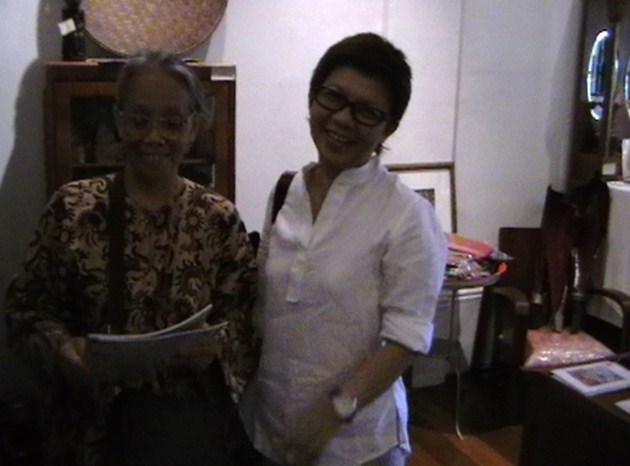
Smiles from Lely and AsH in her mother's baju kurung 

But this textile archive does not stop here.  Into her patchwork Mak also sewed these pieces:

Cool Cotton bought in India

These two pieces recorded my travels with the spouse in India in the 1980s.  During his sabbatical leave from Leicester University, Iain would make the journey to the Academy of Development Sciences in Kashele in the state of Maharashtra.  This institution was run as an NGO to advise and support the Adivasis: India's aboriginal people who live deep in the rural areas.  The Academy ran a clinic, schools, carpentry and light engineering workshops and a large herbal garden for doing research on Ayurvedic medicine.  They were a dedicated group of young and middle-aged Indians, some with their families in tow, who pursued no hidden agenda (like snatching souls for conversion) other than to help to improve the health and education and employment opportunities for a group of people that have been marginalised from India's development.

We began our journey in Bombay (or Mumbai).

Iain's drawing of Pitha Street in Bombay (click to enlarge)

We always tried to get away from Bombay as quickly as possible to get to Kashele.  From Victoria Terminus we boarded the train for Karjat - a journey that took nearly 2 hours.  At Karjat railway station,  we crossed the track to catch the bus for an hour long trip to Kashele.  From there we walked for nearly two hours to reach the Academy.  This drawing tells it all although the spouse made it look like the urban chick walking with him was as tough as old boots.

Kashele - here we come. huff, puff, puff!

But, once we got there, our sojourn in India took on a very fulfilling turn.  There was so much to see and to learn from.

Iain recording the activities of the young Adivasi workers.

For a city girl from Singapore, it was for me, initially, a real culture shock.  But you soon learned to find space in the shrubbery for your very own private toilet, to spend the nights by oil lamps and starlight, to make a fire to boil water for a mug of tulsi tea.  (You picked the leaves from wherever you found it growing.)  You also learned to take a bath and to do your laundry in the river with the other ladies during the early mornings.  And you took off your hat to this little Community for their inspiring commitment and enthusiasm.

There was much joy and camaraderie in our relationship during the time we were there.

With three lovely ADS workers

No fancy hotels, no beach getaways, but the time we spent at Kashele was one highlight of my life in the 1980s - helping to quell and soothe the trauma of my youngest brother Akim's death in 1982.

I have never forgotten those wonderful people and at 69, it's so heartwarming that I will always be reminded of those marvellous times.

AND IT'S ALL BECAUSE MY MOTHER MADE ME A PATCHWORK BEDSPREAD!


Sunday, 24 April 2011

Mothers - (CsH)

Walking around and about Leicester these past years I observed many mothers pushing their tiny tots in prams and baby buggies.  Some of these portable kids look as old as 4 or 5 - they should be walking!

I do feel sorry for these little children for all they get is a worm's-eye view of the world - merely visions of shoes, feet, sandals, trousers, edges of skirts and coats (depending on the weather).  They also breathe in a good dose of carbon monoxide and dust especially when they are being trundled on the roadside.

I also note the same habit in Singapore in the last few years although not so much in Malaysia.

I remember a train trip from Bombay to Neral, sometime in the early 1980s.  I was standing next to an Indian lady carrying a toddler in her arms.  We both had to stand for the duration of the journey, which took over an hour.

I could not help but notice the bonding between mother and child.  Each time the train came to a shuddering stop, the little one would clutch her mother's neck for comfort and the mother would reciprocate with a little squeeze. The child would play with the mother's colourful plastic bangles.  It was like she was counting them or sorting them according to colours.  But that was how the toddler kept placid and happy.  This was a very poor mother and child and certainly the mother's arms must ache from carrying her baby.  But I do think  they derived a great deal  of reassurance and solace from this physical proximity, especially for the child.

You can't get this stuck in a baby buggy can you?

I have also been stuck in my own rut, sorting and scanning the old black/white family photographs.  I was quite chuffed when I found photos of  mak mendukung  my brother Mus.

Singapore Botanical Garden, 1947.
I also recalled how she would carry Akim in an emban just like these Malay ladies from some years ago before my mother was born.  It took me a couple of days to excavate these pictures from my treasure trove of pre-war and post-war books.


From a 1930s Journal of the Empire
The caption for the above picture reads  :

SON O' MINE :  A MALAY GROUP IN SINGAPORE.
Malays are devoted to their children who up to the age of fifteen and sixteen are most engaging creatures.  They trot about with their parents, and when a baby is tired, the mother swings it on to her hip and twists a sling for it out of her sari [it's actually a longish and wide selendang or a sarung]  to which it rides happily and comfortably.

This came from a 1936 Primer

From Grace Garnier's "Paddylands" circa 1930s (?)


Mak (2nd from right)  and her mates in Geylang 1940, I think

Mak would carry on with her  cooking and cleaning and sweeping the house while carrying Akim in her emban.  He would fall asleep in her arms as she got on with her domestic chores - lucky devil!! 

I can just imagine the sense of security and snugness that these bairns absorb just from being tucked in so close to their mothers.

I  recognize that feeling.  Whenever there occurred a thunderstorm at night, mak would come into our bedroom, cover the mirror with a blanket and then move over to our bed to pull the blanket over us. That intimate touch and the scent of her closeness was magic comfort and I fell asleep again knowing that I was well-protected from the thunder and lightning and the storm.


Akan ku abadikan keramat kasih-sayang mu.

Monday, 27 December 2010

PITY OR COMPASSION ?


The above comment by Stirling Road moved me to do this posting, a detour from my train trip.

I am so pleased that the photo on my side bar touched him/her so deeply. It has done what I hoped it would do - to remind us of a "lonely world only the boy and the cat share".


In reply I would like to post  my encounters  with children  during  my travels in the 1980s and 1990s.

I remember our experience in Malaga (Spain)  sometime in the 1980s.  We were sitting and resting on a bench placed by the side of this big avenue watching a number of Gypsy children aged from 6-12 darting dangerously between and in front of cars  trying to sell some items to the drivers.  At times we flinched because these children were taking great risks in their attempts to sell their goods.

Then one of them, a little boy of about 7 came to us with a packet of tissues to sell.  We were sick and fed up of being bothered by touts on our holiday.  But  this was just a child and we had seen him dicing with death on the avenue.

We felt so sorry and sad.  Yes, Stirling Road we could not  hold back those sentiments.  But pity had no place in our thoughts because  it is patronising and condescending and arrogant.

We paid for the tissues and gave him much more than he expected.  We saw him run to his elder sister to give her the money.   Within a few minutes she approached us with more packets of tissues in her hands.  And we were aghast.  We're being taken for a soft touch - she's going to dump more of her stuff on us.  We should have realised these were Gypsy kids and they are canny and sharp.  Those were our thoughts.

There followed  a series of gestures between this English-speaking couple and the Spanish-speaking Gypsy girl.  We were saying 'no, no' and of course we could not decipher her retorts as these packets of tissue were being shoved between her and us.

Finally in exasperation she left the tissue-packs on our laps and ran off to join the others to carry on doing her 'job'.  It then dawned on us why she did what she did!  She was  giving us the tissues because earlier, we had paid more than we should.  She was not trying to sell us more.  She would only take money for what  had been  sold.  To her it was a straightforward business deal.  She did not want charity.  Or pity????

We felt ashamed of our doubts and our fears of these children .  They had more guts and honour than all the politicians in Spain or Britain or Malaysia  put together!

But  I must also confess to being insensitive and unkind to child-beggars.  I was waiting alone while the spouse had gone off to buy our train tickets  at Bombay's Victoria Railway Station. I soon  found myself encircled by a dozen or so small open hands begging for money.  They were moving their hands from patting their  stomachs  to pointing to their mouths and then to your face.  These were gestures of deprivation and poverty that I was confronted with, day after day after day,  during our trip in India.

I could not cope any more with these 'assaults' on my conscience, on  my sense of guilt and the  unremitting poverty of  the Indian sub-continent.  But more than anything else what angered me was the obscene  gap between the rich and the poor.   I put my hands to my head and yelled  " Go, go to Rajiv Gandhi!!".  He was the Prime Minister of India then.  And they all fled and I stood there in tears.

You see Stirling Road ,  I could not give them feelings of sadness or pity or encouragement.   I was enraged and furious at the INJUSTICE.  Why should these children suffer while others live in the lap of luxury? 

I felt the same for that child from  Pusat Tahfiz Amal.  I have given up on most cries for  "charity and love" for the poor and the oppressed.   Charity only gives the donor a feel-good  experience, like giving themselves a pat on the back.  Giving just love to the destitutes  is an insult to them and at times self-serving.

For as long as injustice prevails, when the rich and powerful amass wealth at the expense of the country and its people, everything else being done is marginal, like sticking a piece of  plaster on  an oozing gangrene.

Thank you  Stirling Road for your insight and compassion.  Your childhood is very much like that of  Jailani Abu Bakar (posting on 8 November)   and you both have turned out to be kinder and sensitive human beings.

Tuesday, 28 April 2009

With Spring in my steps (CsH)


With thanks to tauberfanlehar

"We'll gather lilacs in the Spring again" written by Ivor Novello is special to me for two reasons. For years, this tune which I once heard somewhere in my childhood had been floating in the back of my memory box. Perhaps I had heard it on the radio. Or maybe from a vinyl which my father played on our radiogram in our house at Pasir Panjang Road. As luck would have it, years later in the early 80s when I was having dinner with my neighbours, Pat and Harold Isaac in Brunei, they played this song from a collection of Ivor Novello's best hits. I was over the moon, it was like discovering a childhood friend. I managed to buy the same album during my wanderings in England and I play the record now and then for old time's sake.

Secondly, about 21 years ago when the other half and I were backpacking in India we heard this song again while travelling on the steam train to Ootacamund or Ooty. We had been travelling for weeks and almost on our last legs partly because of the heat and the travails of coping with the Indian Transport System. But also we were beginning to feel depressed at the inhumanity of man to his fellow-men and at the grim and unrelenting and widespread poverty in India. But more than this is the gap between the rich and the poor - which to me is quite obscene in the then 20th century. That I will talk about later.

This train to Ooty was an escape for us. We were sitting comfortably in the train, after a bit of scrambling for seats mind you, when we heard this very same song wafting through the train's steam clouds. Someone in the train must have picked it up from some radio station somewhere. We looked at each other in disbelief and tears were falling from Iain's eyes!!. The spouse has no great attachment to any particular flag or country because his childhood was very, very, nomadic. These were tears of relief and respite from the intolerable strain of travelling in India. For we were in our 40s and we chose to keep away from the upmarket mode of touring India. Physically we could handle the journey, but our spirits were quite demoralised at what we observed and experienced in this country - the world's largest democracy.

Hence the beauty of this song. On the coach from Heathrow to Leicester, we could feast our eyes on the yellow gorse along the motorway, the yellow carpet of fields of rapeseed. I was too late for the daffodils. But when we got home, Jack, our dear friend gave me a bunch of white and yellow jonquils and daffodils, bluebells, and purplish red tulips from his garden . As for the lilacs, we'll have to take a little walk to enjoy their fragrance.

After 6 months absence, it's so good to be back in my little terrace house set amidst Leicester's multi-cultural, working class district. The workers at the local Co-Op, the butcher, the greengrocer are all from different parts of the Indian sub-continent like Gujarat, Punjab, Bangla Desh. But the volunteers working in my favourite shop, Leicester Animal Rescue are all English.

Only 2 days ago, the doorbell rang, the spouse opened the door to 2 young Caucasian Mormon evangelists. Before they could utter a word, the spouse told them in a friendly way, "I better warn you lads, you won't get far with me. I'm a Muslim." I wish I could have seen their faces. They then asked, "Where are you from?" The answer given was "Hereford .... England." Next question, "How long have you been a Muslim?" Answer : "Longer than you have been a Christian." Several other questions followed, they were really trying hard these kids. You have to give them credit for that. In the end they gave up and they left with best wishes of "Good-bye, God go with you" from the spouse. This very non-white area has become good hunting ground for evangelists from various shades of Christianity partly because they have given up on the indigenous population of England - who are seen as beyond redemption. It's more rewarding for them to harvest souls from Hindu and Muslim believers.

But for all the joy of being back in England - this is where I really belong - this call always pulls at my heart and soul.


With thanks to Truly Unforgettable