Showing posts with label LCP. Show all posts

Wednesday, 27 November 2019

Something is rotten in the state of Malaysia Baru.


The title comes from William Shakespeare's 'Hamlet' when Marcellus said "Something is rotten in the state of Denmark."

But in Malaysia Baru, putrefaction is a better word than rot.  The rot started with the previous government and putrefaction began to set in after GE 14.


The skin tissues refer to my Tanah Air.  The  anaerobic bacteria emanates from the present ruling regime.


Source : Wikipedia


And the product of their regime consists mainly of bucketsful of  bacterial gas.


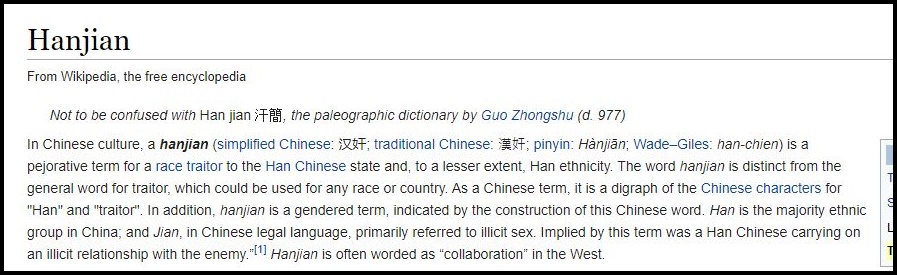
One of the most pungent and toxic output of this squalid Alliance - of  Hope (?) is when certain quarters among the so-called  Anak Malaysia / Bangsa Malaysia slyly -  with the the support(?), connivance(?) and blessings of those in the know - arranged the import of the ashes of this traitor.    And on Malaysia Day of all days!

" Chin Peng  instructed Eu Chooi Yip, the chief CPM strategist running operations in Singapore from Jakarta to "sabotage" merger and Malaysia."  Above image is from
http://thelastlibertybroadcast.blogspot.com/2014/11/history-for-historys-sake.html


What do other other people and nations - I mean people who have sovereignty and pride in their own Motherland /Fatherland - do to collaborators and traitors?


Although in the UK, some of the traitors and collaborators of the Second World War escaped punishment because of their connections and class.  It would seem that Lim Chin Peng, the Secretary-General of the Malayan Communist Party also had strings to pull from the members of his tong pau (people of the same womb) - together with some Malay and non-Malay "sympathisers".


From Wikipaedia


Notice the pecking order of the label  for the Communist Party of Malaya - English, Mandarin, Malay and Tamil.  Exactly the same as in Singapore - though they do have a majority of 70+% Chinese.

" Lu olang Bulayu Malaysia jangan bising bising.  Gua ata tulis dalam Jawi."  

Isn't it wonderful!  In today's Malaysia Baru, we are not allowed to learn Jawi in our schools!!

What more lu olang mau?

Taukeh  we want our  .......


Negara ku, Tanah tumpahnya darahku.


And this was also the oath taken by  Sgt Chee Sze Hsien(rtd)  when he responded to Taukeh Koon Yew Yin's demand that members of our Defence Force should be shunted to take the place of foreign workers in Felda estates.     Something similar to Koon's suggestion took place during China's Cultural Revolution (1966-1976) when Communist China's intellectuals were transferred to labour on  the farms as part of the "Down to the Countryside Movement".  But being an enterprising, canny tycoon, Taukeh Koon YY picks on the Askar-Askar (as most of them are Malays) not the shiftless young urban elites.


But then a brave and loyal Malaysian challenged this arrogance of Koon YY from Ipoh.


The Malaysian Armed Forces "did what we did because we want our children and your children to live in a better Malaysia."  Without "peace and stability " there would be no GAMUDA for Taukeh Koon YY and all his enterprising cronies who now make up the Financial Warlords of Malaysia.

I chose Sgt Chee's bold statement because it would, in the eyes of Taukeh Koon (and Taukeh LKS) carry more weight than a "lazy, unreliable, untrustworthy" (adjectives used by the PM of Malaysia Baru) lowly Askar Melayu.

And now we are told that the ashes of the leader of the CPM, a man who led a bloody insurrection which killed and maimed our civilians and young men in the Armed Forces and the Police Force - and a man who lived to the ripe old age of 90 - has been smuggled in by collaborators known only to the "Elite".

Oh Malaysians (some, not all).  You have no shame.

You can construct a mega-shrine, a humongous to'kong for LCP on Genting Highlands and cart his ashes and sprinkle them all over Gunung Tahan, but it doesn't make an iota of difference to the Malaysians who matter. A terrorist remains a terrorist wherever his ashes are scattered.

But think about it: what a fitting little scenario........  that the remains of this "Great  Leader" had to be surreptitiously smuggled into the Semenanjung like packets of amphetamines and sabu. 

Long Live Malaysia Baru!  Long Live the Reformasi!   This will certainly boost your chances in GE15.


Wednesday, 16 October 2013

The Canonisation of Lim Chin Peng - Blood or Ideology?

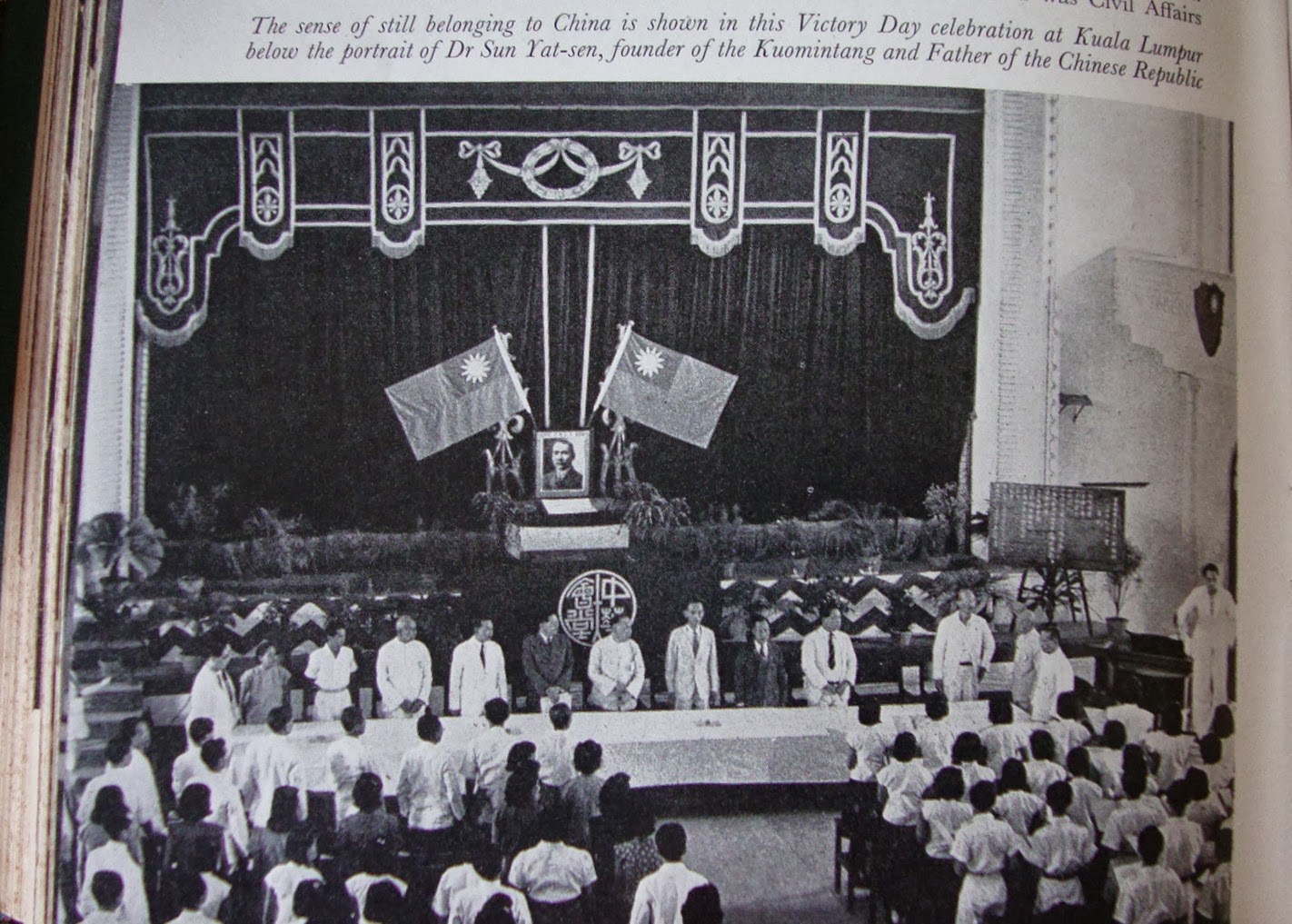
"The sense of still belonging to China is shown in this Victory Day celebration at Kuala Lumpur below the portrait of Dr Sun Yat -sen, founder of the Kuomintang and Father of the Chinese Republic."


A commemorative plate to celebrate V-Day.  The spouse bought this in a shop in Chinatown Singapore in1987.


Now that I'm at the cusp of my seventh decade, and having started on a regime of pill-popping after  breakfast, lunch and dinner, I thought I'd give myself a break and take a sabbatical leave from writing.  So, I looked up my embroidery books, my boxes of silks and aida fabric with the idea of getting back to a more placid domestic activity like sewing.

I'm still bemused by a comment made a couple of years ago by someone (obviously a male) who was  so narked with me for challenging his opinions that he ordered me to get back to my wifely duty of ironing my husband's shirts!  But AsH doesn't do ironing.  At least not shirts.  Instead she got tempted into ironing out crooked thinking - after she'd caught sight of an obituary on General Vo Nguyen Giap  in the Guardian, 4 October 2013.  Why?  Because it reminded her of Giap's contemporary Lim Chin Peng who'd died just a month earlier - and the question of context.

Giap (1911-2013) was a lawyer trained at the University of Hanoi.  "As a child," said the obituary, "his sense of nationalism had been nourished with stories of heroic Vietnamese generals and their victories against the Chinese and Mongols".  He was a brilliant general, "well-versed in Marx and Mao Zedong's writings on guerilla warfare".  But he often said, "We fought our wars in a Vietnamese way.   My only influences were the great strategists of Vietnamese history". Together with Ho Chi Minh, with the support of the Vietnamese Kinh, largely regarded as the 'standard Vietnamese'  identity, Giap orchestrated the defeat of the French in 1954 and of the US and its puppet South Vietnam in 1975.

South Vietnam was not only strongly Catholic. It had a concentration of the Hoa or Sino-Vietnamese, who'd migrated to Vietnam after the fall of the Ming Dynasty in 1644.  Before the fall of Saigon in 1975, these people had dominated Saigon's business and commerce.  Inevitably they also made up the bulk of the 'boat people' who subsequently fled Vietnam. Today, however, the Hoa make up only a small percentage in an economy which is now run mostly by Vietnamese.

ANOTHER WAR : SAME IDEOLOGY, DIFFERENT CONTEXTS

History, as we know, is written by the winners. So, our analysis of history, its events and personalities, needs to be considered within a clearly-stated context to be understood.  In particular, who stands to benefit from the writing?  And who defines the terms: who defines the crooks and the heroes, the monsters and the saints, the terrorists and the freedom fighters?

Take those last two labels.  They have been bandied about, and manipulated (implicitly and explicitly) to fit into many different agenda by accredited academics and other opportunistic 'rogues, rascals, and scallywags'.   "One man's terrorist is another man's freedom fighter"- how many times have we heard that cliché?  Often, no doubt, when talking about Palestine. And increasingly, nowadays, when talking of our own recent history here in Malaysia.

Now that LCP has departed, there seems to be a revival of the urge to rewrite Malaysia's history - most especially that of the period from 1930, through the Japanese Occupation and the 'Emergency' to Merdeka. And especially the role of LCP.  So how do we make sense of the various events and personalities that make up that history over that time?  Perhaps we need to look at the context - the context of both time and space.

In particular, the time of the post-1948 Emergency (or perhaps 'Insurrection" is a better word) coincided with the demands and wars for independence from European imperial powers.  It was also the period of the Cold War between two competing ideologies, Communist and the (so-called) Free World - and it especially saw the rise of Communist China and the war in Korea.  But the 'Emergency' had a longer  (and more particular) formative history than this.

In any analysis of the 'Emergency' the context of space is crucial.  It was the space of the Malay Peninsula or Semenanjung Tanah Melayu, not just such British appellations as The Straits Settlements, The Unfederated Malay States, The Federated Malay States, The Crown Colonies, Malaya or the Federation of Malaya.  And this space of the Malay Peninsula, before the onset of colonialism, was not a void, any more than Africa was a 'dark continent' to be discovered, carved up and exploited. No, the Malay space was already a complex cultural and political reality.

It was made up of several sultanates each with a long history of its own.  Of course it was feudal, just like Britain, France, Holland, Spain, China, Russia, India and many others once were. These sultanates had systems of government that presided over their society and economy.  If academics and liberals in Malaysia and overseas, choose to describe this part of the Semenanjung's history as decrepit, corrupt, piratical and unrepresentative, well, so were all other feudal (or not so feudal) societies.  And let us remember: the history we were brought up with abounds with Malay pirates - but is very shy of talking about the many white ones (like Sir Francis Drake, Henry Morgan and other "privateers")) who crowded the colonial past.

Anyway, from the 16th century on, our space was invaded, 'carved up and exploited' by Christian Portuguese, Dutch, and British soldiers, adventurers, merchants, carpetbaggers and missionaries. These people came, they saw, they conquered - they  ravaged the landscape for profit.  Not only that, they (and especially the British) re-designed and manipulated the original demography of the Peninsula.......

British Immigration Policy very almost made the Malays a minority in their homeland.
........ creating a landscape of entrenched economic disparities, language and educational  exactions and toxic issues of race and religion.

The Peninsula was like the Goose that laid the Golden Egg. Naturally the ones with the right tools and better techniques and loadsofmoney, those from the Metropolitan nest, got the best. In the middle were the 'enterprising' immigrants - loaded with business acumen, thrift and a good dose of what the Brits saw as the good old 'Protestant Ethic' of diligence and hard work.  They knew what, when and how to harvest the benefits, playing the role of the deserving and dependable middle man.  It was an economic playground where the native denizens were outside the fence looking in - picking what they could - except, that is, for a few carefully cultivated members of the elite.  

So, this was the situation, just after the Second World War.  Soon, almost all colonies in Southeast Asia were involved, in one way or another, with fighting for independence.  And the 'Cold War', of course, was always there.  The Malay Peninsula, like Vietnam, was sucked into a bloody conflict fuelled by Communist ideology - each with its leaders, its victims and its heroes.  Each had its own particular context - or versions of context, as defined by the observer.

It is the context that defines the heroes.  And this is what I thought when I read about General Vo Nguyen Giap - and Lim Chin Peng.  Each man is considered to be a hero and a 'freedom fighter'.  Now, I can understand giving Giap such a label: after all, the Vietminh and the Vietnamese people fought a long war of independence from first the French and then the Americans.

But  Lim Chin Peng is a different kettle of fish. For LCP, the Malayan Communist Party, the Min Yuen, the Malayan People's Liberation Army, the Chinese squatter-supporters and the Chinese language teachers and students, it was not just a matter of ideology - of a revolution to overthrow the capitalists and install Communism, to replicate the victory of Mao Zedong in China in 1949, or a struggle for (Malayan) 'national' liberation. It was, as much as anything, a matter of race.  The table below tells enough.

-

It has to be made clear that LCP's and the MCP's agenda did not begin with the insurrection of 1948 . Chinese nationalism - both in China and in the overseas territories where Chinese migrants had ventured, and whether inspired by the Kuomintang or the Communists - was born in the early 20th century as a result of foreign incursions into China, the collapse of the Manchu Dynasty and China's humiliation in the wars with a smaller Japan in the 1930s.

In the Malay Peninsula, LCP's much lauded service in defeating the Japanese ( in alliance with the British imperialists) was not fired by love or loyalty to the Semenanjung : to Kedah, Perlis, Kelantan, Pahang, Trengganu, Johor, Selangor, Perak, Penang or the island of Singapore.  Crucially, their spiritual fount for participating in the MPAJA  was their Middle Kingdom - and the desire to kick the hated Japanese in the teeth.

Responses to Japanese advance in Southeast Asia
Likewise the goal of 'liberating' Semenanjung Tanah Melayu from British imperialism was to a large extent a a fig-leaf to hide the intention of setting up a 'People's Republic of Malaya' which would to all intents and purposes be Chinese-inspired and Chinese-dominated - an Ali Baba revolution and republic.

But these days, such things are conveniently forgotten by many a well-heeled (and hardly leftie!) commentator. The Friends of LCP now use the Japanese defeat and the achievement of Merdeka to rewrite history - with a particular eye to justifying the consecration of their hero from 'terrorist' to 'freedom fighter'.  They claim that LCP was traduced by the authorities and other Malaysians (especially the Malays).  Even before his demise, a noisy  'agitprop' had been organized among the DAP, MCA and some 'holier-than-thou' academics.  There were, of course, some liberal Malays jumping on the bandwagon - sporting fashionable ideas without giving them much thought.  These are the proverbial 'kacang lupakan kulit' and in  Belacan Malay parlance we call them Pak Torot.

Yes, we all know that in its attainment of Merdeka, the Malay Peninsula was uniquely ( and boringly) devoid of fiery, charismatic leaders - of  'National Freedom Fighters' - like Mahatma Gandhi, Sukarno, Ho Chi Minh and Nelson Mandela.  Now, some want to fill the gap.  But with Lim Chin Peng??

For many, like myself, the choice seems bizarre at the very least.  Until, that is, we ask one or two pertinent questions.  And perhaps the key question is about the motives of LCP's  present advocates.

Had LCP and the MCP come to power, the urban "bourgeoisie" (middle class) of financiers, merchants, academics, lawyers and other professionals would have had a pretty hard time - in theory at least.  If LCP had won, the compradors would be out of jobs - in theory at least.  And yet some of LCP's most ardent advocates are precisely such people.  LCP, they say, was a 'nationalist' and a 'freedom fighter'- but whose nation, and whose freedom was he fighting for?  So, another question poses itself: is LCP's promotion, by people who cannot possibly share his ideology, more to do with political opportunism and the tangle of racial politics in Malaysia - and rather less to do with honouring our national heritage?

And that raises more questions.  Have they taken into account those Malaysians  (mainly Malays)  whose fathers, husbands, brothers and sons - and other civilians - were victims of  Lim Chin Peng and his ethos that "political power grows out of the barrel of a gun" (Mao Zedong, 1938)?   In addition, is there any reason whatsoever why Malays should celebrate LCP as a 'freedom fighter'?  This, I think, is the nub of the issue about "context".

'WHAT IF?'

Of course LCP and the MCP  despised the British capitalists and their presence in the Semenanjung.  But would they have been averse to using the same tools that the British used to run the economy - and to 'manage' the native Malays?  Imagine LCP in power in Malaya.  How would the Peninsula's wealth have been re-distributed according to the Communist ethos of  "no private ownership of the the means of production and "from each according to his ability, to each according to his need"?  There would be no taukehs, no tycoons, no rubber king, no rice king, no sugar king, no Genting moneypot, no property developers, no stock exchange speculators.   You'd get jobs through a Politburo.  You may even have to serve in the Army - and/or suffer National Service to boot.

Or would you?  Perhaps LCP, as the son of a petit bourgeois (self-employed) from Sitiawan, may have come to realise that you do not kill the goose that lays the golden egg.  Perhaps his Communism would have been re-oriented to enable the bourgeoisie (shopkeeping and mercantile middle class) to "have its cake and eat it too"- as with Hong Kong.  Furthermore it would be very easy to achieve and sustain because the Chinese-based economic/capitalist infrastructure had already been secured during the period of Imperial British Capitalism.  Perhaps LCP's modern advocates know this was his intention - or at least what he'd end up doing.

And what of the Malays?  Culturally of course, the Malays and the Chinese are as different as chalk and cheese - and a Communist ideology largely inspired in China would hardly have bonded the two on fair and equal terms. Besides, strictly speaking, the Malays were the wrong kind of proletariat: they were not wage earners and industrial workers, they were mainly yeoman small-holding peasants, self-employed on their own  or rented land growing rice and small-scale cash crops.  Certainly padi-farming would be nationalized and national rice targets would be imposed.  Would the kampung survive?  Or would private property like kampung houses be replaced with some sort of communal barracks?  As for all the other native 'running dogs' of imperialism (especially those in the police and armed forces) - well, such 'traitors' would naturally have to be 'encouraged' to recant and abandon their ways.

For the Malays it would have been merely a Changing of the Guard, from a White Christian Britain to a larger Sino-Communist Order.  But there would have been nothing like the arrangement back in the time of the Melaka Sultanate, when - despite the tribute of Bunga Mas - China left the Malays to rule themselves, and to flourish or fall within their own system.  No, this New Order would have all the trappings of a much more rigid subjugation.

An irrational fear?  No, not then.  Remember, the 'Emergency' had come hard on the heels of the aborted (by the Malays) Malayan Union - which had already shown the Malays a measure of how their 'patrons' would betray them, given half a chance.  And Malays had seen too what had happened to Muslims in the Soviet Union - and what was happening in China.  Let us not forget this context.  For my grandfather's and father's generations, there was real fear that LCP and the MCP were on the side of those who wanted to turn their Tanah Pusaka into something very dreadful.  Malays would end up like the First People of North America, or like the natives of Taiwan.  They would be a people who "Hidup Segan, Mati tak Mahu", (too embarrassed to live, but unwilling to die).

The first cut was when Christian Europeans came to exploit and subjugate their world.  LCP and MCP would have given the finishing stroke.

An so, to the admirers of LCP, to those who want to consecrate him as a 'national hero' and a 'freedom fighter' who deserves to "come home", I say this: just consider the context of your self-serving whimsy - and be a bit more sensible.

Remember, it is not only Malays who would have suffered.  If the Peninsula had been turned into the People's Republic of Malaya, we might be celebrating LCP's birthday on 19th October.  Chairman Lim Chin Peng's Little Red Book would be a compulsory text in all schools - where Malay would certainly not be the language of instruction.  (Remember how Malays and everyone else had to learn Japanese during the Japanese Occupation?)  Religion, as the "opiate of the people", would be banned - no Hari Raya or Ramadan (like in Xinjiang), no Deepavali or Thaipusam, no Vesak Day or Easter or Christmas.  Luxury western products, holidays to Disneyland, gambling at Genting would be banned.  The Internet, Twitter, Facebook and the whole IT caboodle would be closely regulated.  As for Campaigns like Bersih and Seksualiti Merdeka - dream on, babe!

Just think of the 'creativity' which would have been stifled.  Think of those arty salons and liberal talking shops in Georgetown and Kuala Lumpur.  Think of the joys of Central Market for our younger (and freer) generation.

You can be sure that there would be no such thing, in Chairman Lim's Malaya, as "The Emergency Festival".
And I wonder too: would Alvin and Vivian dare,  or even want,  to show their faces (?) - and mock Chairman Lim enjoying his caviar, pate de foie gras and his Dom Benedictine?

The prospect would be too awful to bear, wouldn't it?  Think of the exodus there would be. Think of all those (including our liberal Malay Friends of LCP)  who would be scampering to get on the first boat out of Malaya - with or without gold bars.

So, really, it's not about ideology at all, is it?  If it was, most of LCP's latter-day advocates would be switching off their mobiles and running for cover.  No, in the end, this farce about LCP's legacy is really about blood.  Tong Pao. Race. And it always has been.  And when blood trumps ideology, principles, justice ..... there is always a cause for serious worry.

.... And the Moral?

Today the Peninsula is a part of Malaysia - a federation comprising the southernmost fingertip of Eurasia and - a thousand miles away - two chunks of the largest island in Asia. Geographically, it seems absurdly disconnected.  It has some things in common: most especially, it was all once part of the British Empire. But   I cannot think of any political configuration that is so complex and so diverse in terms of its geography, its people, culture and religion.

In the Semenanjung itself, the Empire left us with a vulnerable economy and an easily-combustible demographic structure. One huge explosion was put out in May 1969.  Since then our fire-deterrent system has been quite effective - but only because the residents were more keenly aware of the peril of another fire. We all have a lot to lose if that happens.  Some of us, of course, can afford to get on a boat/plane and like other earlier migrants make a better life elsewhere.   But many can't or won't -"hujan emas negri orang.....". This Tanah-Air is all they have and for people like our two road sweepers, Man and Aisha  - they will stay put, and live and die where they were born. There are millions more, of different shades and hue, like them in Malaysia.
[Just to save us all the hassle of snide comments later: I happen to be in England just now because it is my husband's homeland and he needs to be here.  I have not acquired a British Passport and I am no Mayonnaise Malay - just an old-fashioned  Melayu Belacan.    End of story]

When Winston Churchill talked of giving  "blood, sweat and tears"  his nation was facing a dire situation. We have shed enough blood and tears in this country of ours.  Because of more than a hundred years of self-serving British economic and immigration policy, we cannot now have the luxury of a homogenous population like Japan, or one where one group forms a large majority like in Singapore. It's comparable, maybe, to a ''marriage of inconvenience"!   Keeping together involves a lot of hard work in the spirit of "give and take".  This is a blessed, bountiful country - let's do a lot more giving instead of taking.  Let's be more "timbang rasa" - to balance and to feel - for others.

So let us all be thankful.  Be thankful and think : "There, but for the grace of God, go I - and my country."  Be thankful too for the older generation of patriots, who were willing to put their lives on the line for a freer and more inclusive "Malaya" - and to secure the "good life" most Malaysians now enjoy.

And, for all our sakes, leave  Lim Chin Peng alone.  As terrorists go, he didn't do too badly.  He lived to almost 90, died in a hospital bed, and was duly cremated with family and friends and admirers around him. If we consider the fate of other terrorists/freedom fighters in recent times, LCP in the end was a very, very lucky man.

That is the final context.


Happy the people whose annals are blank in history books.  (Thomas Carlyle 1795-1881) 

                                               ****************************

For more details regarding the activities of the Kuomintang, the Min Yuen etc. , read the Unrepentant Malaikwai's posting   http://anaksihamid.blogspot.co.uk/2011/10/between-python-and-cobra-csh.html

Malaikwai or Malay devil is a derogatory term for Malays used by the Chinese in Singapore.  In similar manner they also use Kalingkwai and Angmokwai.  These terms are not much articulated nowadays but the underlying spirit of contempt is still there, albeit in  different formats.

Saturday, 29 October 2011

Between the Python and the Cobra (CsH)

This posting is dedicated to our Pahlawan,  past and present.

Ya Ilahi Tuhan-ku Rabi!
Pokok yang rendah menjadi tinggi!
Sa-lama kuching tidak bergigi,
Tikus tidak bersopan lagi.

Pileh2 melipat kain,
Jangan termasuk baju kemeja.
Pileh2 tempat bermain,
Jangan di-patok ular yang bisa.

THE FIRST BATTLEFIELD IS THE RE-WRITING OF HISTORY  -  Karl  Marx.


54 years after Merdeka and 63 years after the declaration of insurrection by the Malayan Communist Party (MCP) we are once again being taunted - this time by a rising clamour from Friends of Chin Peng (FOCP) for the canonization of the terrorist Lim Chin Peng (LCP), the leader of the MCP since 1940.  Some of the voices are hesitant and timorous; others are loud and self-righteous.

The champions are both local and foreign.  Sharing the same bandwagon are academics, historians, Salon-Lefties, dinosaur Marxist-Leninists, 'radical' writers, young wannabe revolutionaries, slick journalists, opportunistic politicians and a motley crew of Political Fashionistas.

They have woven a fabric of myths around LCP and his Party.

1.  The first myth is that LCP, who led the bloody insurrection from 1948-1960 and again from 1967-1989 is a national hero who deserved the status of Malaya's foremost, if not the first freedom fighter, our liberator from British Imperialism.  Dr Chen Man Hin  (DAP Life Advisor)  for one, regards LCP  as a 'freedom fighter'.  LCP's champions all agree his return to Malaya should be granted and lauded.

Really?  Let's look a little more deeply into the matter.  Let's examine the context of that critical period after the Second World War.

In February 1946 Stalin declared that for as long as capitalist societies existed, wars were inevitable.  Then in March 1946 Churchill coined the term 'The Iron Curtain' and asked that all English speaking countries should stand together against Communism.

And Mao Tse-Tung, whose Chinese Communist Party  (CCP) did not gain victory until 1949 responded; "world war should be avoided but there should be no compromise towards internal conflicts". 

The Cold War had begun.

In Malaya, of course, 1946 also witnessed a huge protest by the Malays against MacMichael's Malayan Union, which would have reduced the Malays to a minority people in their homeland and lose them their political clout as well.  This period also saw the formation of UMNO.  As in other colonial territories, the worm was beginning to turn, but not without severe complications.

During WW2, LCP and the MCP fought with the British against the Japanese.  Their participation in the MPAJA  (Malayan People's Anti-Japanese Army) has often been extolled as the Communists' unstinting loyalty and sacrifice in Malaya to expel the Japanese.  Indeed, after the War the British awarded medals to LCP and other CPM leaders for their services.

They were not of course the only ones who deserved such recognition for defending Malaya and Singapore: remember Lt. Adnan Saidi and his platoon from the Malay Regiment who paid a heavy price with their lives fighting the Japanese at Pasir Panjang Ridge, Singapore.  It took some time before history text books in Singapore were willing to acknowledge the Malay Regiment's ultimate sacrifice.

However, there is one difference between this and the MCP's commitment in the MPAJA.  The Malay Regiment were in battle for the sovereignty of their tanah air.  LCP was not fighting as a patriot of Malaya but as a revolutionary inspired by the wider world vision of Communism and by the humiliation that smaller Japan had inflicted on  larger China from the 1930s.

The MPAJA were motivated by their hatred of the Japanese and what they did to China after the 1937 invasion.  And when the Chinese in Singapore and Malaya were picked upon by the Japanese during Occupation, it was a continuation of the violence and hostility already evident in China.  The bitter enmity and violence of the Sino-Japanese War had been transplanted to Occupied Malaya, to Ma-Rai-Ee.

After all, the Nanyang (Overseas) Chinese had rallied to the call of the Motherland from both the nationalist Kuomintang and the CCP  for help and aid.  Anti-Japanese supporters ranged from ordinary people to millionaires like Tan Kah Kee, known as the Rubber King of Malaya and Singapore who managed to get enough funding for the Chinese Air Force to buy 13 fighter planes.  Incidentally, Tan departed for Indonesia to escape the wrath of the Japanese.  The Chinese in Singapore boycotted Japanese goods and even Chinese trishaw riders refused to accept Japanese passengers.  Committees like the China Salvation Movement were set up to collect donations from rich merchants and ordinary workers who were committed enough to give regular monthly contribution.  Some even volunteered to leave their jobs and families to serve as motor mechanics and drivers in transporting war materials.

But if loyalty to China was a matter of blood, it was also a matter of ideology.  And when LCP and MCP 'served' in the MPAJA and later turned to armed insurrection in 1948 to begin the People's Revolutionary War, he was fighting as a soldier in the service of both blood and ideology.

So, when the British decided to team up with the Communists in the MPAJA, they became in effect, the patron and godfather of the coming 1948 Emergency.  Both had the same war objectives but different post-war intentions.  By 1943, the MPAJA-cum-MCP already had a strategy to set up the People's Republic of Malaya; and by 1945 there were already 10,000 well-trained, well-armed and disciplined Chinese Communist soldiers in the Malayan jungle.


2. A second strand of myth claimed by the FOCPs is that the insurrection precipitated Malayan independence.  If it wasn't for the Emergency the British would not have given Malaya her independence in 1957!!  This was also LCP's adamant stand.  And so to that extent, they say LCP should be recognized as the father of Malayan independence.

Well, British interest in Malaya was part of a larger design than merely responding to Lim Chin Peng.

Britain may have won the Second World War but 1945 marked the start of the decline of "the Empire on which the sun never sets".  It had been bombed-out, the country's infrastructure was damaged, there was not much left in the coffers.  One by one the colonies got an independence of sorts: India/Pakistan in 1947, Ceylon in 1948, Malaya and Ghana in 1957, Tanzania in 1961, Uganda 1962.  Only Kenya's independence was preceded by rebellion, to thwart the agenda of the White Settlers.  The leader of the Mau Mau rebellion Kimathi, was captured, executed and buried in an unmarked grave.  That was how the British dealt with their coloured dissidents.  Even their home-grown traitor Lord Haw Haw was hung for his pro-German broadcasts during WW2 and buried in an unmarked grave.

But imagine, if the MCP had succeeded in establishing a People's Republic of Malaya - it would be similar to the American War of Independence when the non-indigenous white colonists fought the British for independence, to the considerable disadvantage of the Natives.  There would be one big difference of course; Malaya would become a dollar-earner satellite state (or another province) of the People's Republic of China.  We would have to practise the adulation of the great leader Lim Chin Peng and Lim's Little Red Book would be in every home.


3.  A third strand of the myth is that LCP and MCP had strong Malay support.  Few academics could deny that one major reason for the failure of the insurrection in Malaya was the refusal of the great majority of the Malays to participate, either physically or spiritually, with Communism and the MCP.  Even that pioneer of Indonesian Communism, Tan Malaka gve up trying to recruit the Malays in the 1920s.

Basically Malays do not relish being led by 'foreigners'.  British Colonial authority was tolerated only because the Council of Malay Rulers backed British Administration.  There were of course many Malay nationalists and leftists who were anti-British but they did not see the MCP as an ally.

The lack of Malay support is a weak link in the FOCP's attempt to legitimise LCP and the MCP.  They needed to find ways to suggest that the insurrection was multi-ethnic.  They wrote articles like........
http://www.thenutgraph.com/the-voice-of-the-malay-communists/
...... to support their cynical agenda.  For every Abdullah CD one can easily locate thousands of  Malays whose fathers and brothers and husbands were killed fighting the Communists.

But there is one fact that LCP's champions are loathe to accept and expand.  Membership in the MCP and the Malayan Peoples Liberation Army (MPLA), the militant wing of the MCP was unquestionably over 90% Chinese.

So too was the Min Yuen (the People's Movement), a most potent wing of LCP's insurrection.  These were Commmunist soldiers without uniform and wages who played a crucial role as a support network, living and working for their ideology among the general populace.  Out of 30,000 to 40,000 members, 90% were Chinese, made up mainly of the labouring and squatter classes with the rest from Chinese school teachers and students and professionals.

The Chinese squatters played a decisive role during the Emergency.

At the beginning of the insurrection there were about 500,000 Chinese squatters (15% of the Peninsula's population in 1951) living on the fringes of the jungle, especially on the west coast states of the Peninsula.  In Johor for example, squatters occupied 40,000 acres of land growing vegetables for Johor and Singapore.
This is from my Primary School Malay Language textbook. What is most revealing are sentences 5, 6, 7 and 8..
These squatters  "established settlements on land not set aside for that purpose" and even in the Forest Reserves and Malay Reserve Land.  They came to the fringes of the forest during the post-1929 recession when unemployment was high.  During the Japanese Occupation they did the same to escape repression and also because of a dire shortage of food in the urban centres.

There were also  Malay and Indian squatters among them but their numbers are negligible.  Of course, not all 500,000 were keen on aiding the insurrection but the 'strong-armed' tactics of Min Yuen in extracting food and money and information for the MPLA made certain that the squatters kept the guerillas ticking over.  Also these squatters were not sure that the British could win this 'war' and hence decided 'to go with the flow'.  So effective were the Min Yuen in sustaining the Revolution that by 1951, 200 police and civilians were killed each month - the authorities were fighting a war with shadows they could not pin down.

The Briggs plan to resettle such squatters into New Villages was a device to break the hold of the Communists on their major source of survival.  The objectives and implementation of this scheme make up another story.  Most versions relate to the ruthlessness of the scheme and the impositions on the squatters.  However, rural Malays of that period also had their woes but they were largely untold.

Why was membership in the MCP, the MPLA, the Min Yuen strongly Chinese dominated?  Perhaps we need to look into the cultural make-up of the emigrants.

Even before the 1920s and up to the present, the Chinese in Malaysia and Singapore and in the rest of Southeast Asia had  a remarkable and admirable (depending from which end of the telescope you're looking at) sense of oneness, of a common identity wherever they were in their 'diaspora'.  Only recently (1 Oct 2011) Joceline Tan wrote in The Star , " Chinese from Malaysia and Singapore may see themselves as cousins......"  in the wake of Lim Guan Eng's disparaging remarks in Singapore about another state (Johor) in his own country.
http://thestar.com.my/columnists/story.asp?file=/2011/10/1/columnists/joceline/9609411&sec=joceline

They regard one another as tong pao or 'of the same womb'.  And in that context, in Southeast Asia especially, the umbilical cord between the MCP, KMT, and CCP then, and the Nanyang Chinese and PRC  (Communist China) and ROC (Taiwan) today cannot be severed.

The economic prowess of the Nanyang Chinese and their kin connections in Southeast Asia are almost legendary.  This blood loyalty between colonial emigrants - and between colonial emigrants and mother-country - has been a strong factor in the economic success of the Nanyang Chinese.  But it was a matter of networks rather than genetics alone, as Joe Studwell suggests in his Asian Godfathers: Money and Power in Hong Kong and Southeast Asia. He 'dismisses the common assertion that being Chinese confers an unusually high potential for economic success, showing that the predominance of ethnic Chinese among the godfathers devolves from the colonial era and emigration patterns rather than genetics'.

                                                ==========================

Lim Chin Peng as Malayan Hero :  A Malay View

In this crusade for the resurrection of LCP, his adherents are keen to quote past Malay PMs and other senior Malay voices to bolster their cause. These Malays speak for themselves.  Malays reckon they are being harried to adjust and change their opinions to fit into the FOCPs box  - to have to cut their coat according to other people's size and cloth.

Just think for a moment.  Malay feelings about the Chinese Communists and the insurrection have a lot in common with Chinese feelings about the Japanese in the 1920s and 1930s.

The ousting of the Communists cost the deaths of 1,346 Malayan troops and police (albeit including a minority of non-Malays).  In comparison,  British and Commonwealth fatalities were about 519.  The Malays were not incidental casualties - they enrolled in the Police Force, the Special Constabulary, the Home Guard, the Malay Regiment and as British Army Malayan Soldiers (BAMS), making a stand to defend the tanah pusaka.

All the insurrection did was to aggravate the tension between the two races and intensify the hostility and mistrust.  It is not up to only  the Malays, but also the Chinese and others to face and talk squarely about the causes, the effects and the repercussions of this dark, bloody history.
Promoting the wishes and woes of one man, without consideration of the wider tapestry of   lives blighted during the insurrection  aggravate the dissensions  and serves only to 'menanggok di air yang keroh'.

Malaysia's big neighbour Indonesia often scorns the way Malaya's/Malaysia's independence was seemingly handed on a silver platter.  They tend to ignore the bloody price paid by this country's people and especially the  Police and Armed Forces  to uphold its peace and sovereignty during the Emergency from 1948-1960, from 1967-1989 and during Konfrontasi.

My father and his students from the Malayan Police Force attending the Hygiene Assistant's Course at Nee Soon, Singapore, circa 1950s/early 1960s.


For the Malays in the Uniformed Forces, fighting the MCP during the Emergency was not a simple matter of taking sides.  It was a battle against two outrages in their land - by the Chinese Communists and the British Imperialists.

Turun ka-sawah memakai tudong,
Padi di-huma layu lengkesa;
Sa-ekor sawa (ular) sa-ekor tedong,
Bersama2 mengadu bisa.

Then of course, came the sequel, another insurrection between 1967-1989, (which had the encouragement and blessings of  the People's Republic of China's  Chairman Deng Xiaopeng) which was fought almost entirely by Malaysians.

Conclusion

This campaign to resurrect LCP, so that he can expire peacefully in his bed in his 'hometown' and be buried next to his father, will most certainly persist.  We are fed selective  pictures of a smiling, jolly-looking, rotund elderly man, looking like our taukeh kedai runcit who has been living just next door to us for the last 40 years.  How could anyone have the heart to deny this simple wish of a man who "at the tender age of 18"  (Susan Loone's paean to LCP) joined the CPM, conjuring an image of an innocent choir boy?

There are many men with fewer bloody culpabilities who would not dare to hope for such a benign end.

When the man finally meets his Maker, I predict Friends of Chin Peng and especially the Political Fashionistas will be parading in T-shirts, or ribbons or wrist bands or bandanas adorned with Lim Chin Peng's image and words like Che Chin Peng, a la Che Guevara.  Green caps decorated with a red star (or 3 red stars) will be the latest 'must-haves' to demonstrate solidarity with their cause celebre and to vaunt their liberal humanitarianism.

But then perhaps it is all to the good this way.  What an ignominious fate it would be for the man who wanted to be Chairman Lim Chin Peng of the People's Republic of Malaya - to end as a mere fashion statement.

NB:  All three pantun were taken from Kalong Bunga Buku 1, oleh Za'ba, 1964 (DBP) 

Sunday, 23 October 2011

The Romance of History (CsH)

I hated History.  When you were in the Arts Stream, history was a must to make up the 8 subjects required for the Cambridge School Certificate and the 4 subjects for the Higher School Certificate.

This Examination Time Table shows the nature of the History Papers for the School Certificate. very telling of the times.  They were History of the British Empire and Commonwealth and History for Candidates in Malaya.


Earlier Primary School history was mainly made up of the history of English Kings and Queens and the achievers in the British Empire.   I recall how my my history and geography lessons throughout Primary and  Secondary School referred to the Peninsula -  what is now  West Malaysia -  as Malaya.

 It was in fact a term manufactured by the British to 'create' an image of  a single political entity of the Straits Settlements, the Federated Malay States and the Unfederated Malay States.  Malaya not only referred to the indigenous Malays but also the non-Malay immigrants.  In this way the British did not have to account for the  nefarious (or otherwise) tactics and subterfuge they employed to take over the Peninsula and its resources - in the guise of bringing peace and prosperity to the country.  The 'treaties' they made with the Malay Rulers in their bid to expand their political control became mere details in this larger picture of developing Malaya for the 'benefit' of all.  Also their cynical policy of promoting the entry of millions (from China and India) of what in today's terms would be described as 'foreign workers' to 'develop' and enhance the Imperial coffers would be rationalised and  legitimised.

If the climate had been agreeable to them as in Zimbabwe (the old Southern Rhodesia named after the arch-Imperialist Cecil Rhodes) they might have set up permanent settlements in all the choice spots on the hills, in the most fertile areas or by the seaside and renamed the Malay Peninsula Rafflesia  or  Edwardia!

I have spent all week reading and digging into versions of the History of 'Malaya' from the 1920s to post-World War Two.  What a minefield it was. 

The earlier narrators were mostly British and Australians; more recently they have included a number of non-Malays, some Malays, more Australians and now the addition of some colourful Malay fashionistas  (most  of them, it seems, emanating from institutions in Singapore).  With copious footnotes and citations and reference lists, they excel in presenting a linear history of pre-War and post-War British 'possessions' in the region.  Instead of Kings and Queens  it was all about Sultans ( emasculated and compromised - my description), Residents and Governors and High Commisioners.  There were the European Captains of Industry and Agriculture and Merchant Houses and their immigrant counterparts and the tale of how these were the people who made Malaya then and Malaysia what it is today. 

They hold the view that  'the Malays might have lived in it (the Peninsula) longer, but no one had done as much to develop it as the Chinese'.  This point however, has to be considered.  Although "the vast majority (the Chinese) arrived as labourers, many soon found in the stability and order of  Malaya opportunities for demonstrating their entrepreunerial talents.  Becoming the largest element first in the urban centres and then in the country as a whole,they came to dominate the retail and commercial life of Malaya".  There were no barriers, no competitors , no hazards - success was almost handed on a plate.

As for the natives,  left on their own, the Malays would have remained backward serfs - a sweet but sorry looking lot of  Mats and Minahs who would happily dive into the sea for coins thrown into the water by the wealthy and civilized Others.  The context of Malay culture, political suzerainty, economic activity and  sustenance -  the existence of  Malay peasants and fishermen, small Malay craftwork and industry as well as regional and localised forms of political organisations were marginalised and ignored.  It seemed that the  Malays contributed almost nothing except to allow all and sundry to exploit and profit from the resources in  their homeland while they remained protected  and 'nurtured on subsistence-level' paternalism. Keep them quiet and sedated - that was the ploy.

Words like immigrants, bandits, terrorists, Emergency, communists, nationalists, freedom fighters and liberators  pepper the texts.  The 'left-wing intelligentsia' have done a good job in questioning the choice of words used by the British to describe the post-war insurrection by the Communist Party of Malaysia. Terms like 'bandits' to describe the Communists were later discarded because they give the connotation of MCP guerillas as being 'small fry' like pesky flies that can be easily swatted and worse, that could make them seem almost semi- heroic, like the Robin Hoods of Malaya. Certainly the ambitions of the MCP were stronger than that.

Now the word 'Emergency" was regarded as a typical British understatement of a critical situation.  It's a nifty word because it promises only a temporary hiccup. It also enabled  the owners of the plantations and tin-mines  to claim insurance  for their temporary losses.

But, most of all, this word 'immigrant' fascinates me. Here are its various meanings.

1. a person who comes to a country where they were not born to settle there.
2. one who comes to a foreign country to live there permanently.
3. someone who leaves one country to settle permanently in another and
4. a plant or animal that establishes itself in an area where it previously did not exist.

But the term 'immigrant', as used in texts concerning the history of Malaysia from the 1920s, is a misnomer.

In the first place, the large scale movement of Chinese (and Indians) into Malaya and Singapore was orchestrated  by the imperialists' hunger for cheap labour to work the tin mines and plantations, to construct the buildings, roads, railways and ports, to clear the jungles and later to be the clerks and petty bureaucrats (after a good dose of education in schools run by missionaries) and more importantly to play the role of middlemen traders and conveyancers of lucrative exports (especially) and imports with the cosmopolitan hub, to lubricate the wheels of imperialism.

Secondly they came as transients.  They did not come to settle permanently and  were not, for the most part, immigrants. They were foreign workers allowed entry and permit to make a living and for some fortunate ones, a fortune, by the British Colonial Rulers.  They were sojourners - making a temporary stay in a foreign country amongst people who were not of their culture.  They came to escape  poverty and unrest in their own country.  To 'balek Tongsua ' was a common attribute of the Chinese attitude when I was growing up in the Fifties.

Throughout the 1920s to the 1950s, and even after Independence, the Chinese ( except for some of the Peranakan) did not regard these British outposts as home.  China was their Motherland.  Up to 1948, the 2 million Chinese, many second generation born in Malaya gave their loyalty to their family, their clan and to China. The land of the Malai Kwai  (Malay devil) had no significance for them except as the goose that laid the golden egg.  Furthermore, China allowed them Dual Nationality enabling them to eat their cake and keep it as well.

The concept of "Dimana bumi di pijak, disitu langit di junjung" remained primarily a Malay folly.

Given such a background, it would be very glib to suggest that racially based politics began with the Alliance of UMNO, MCA and the MIC as of the 1957 Independence.  One could safely claim that it started between the 1920s and 1950s when the Kuomintang and the Chinese Communist Party competed for finance and support from Chinese coolies and taukehs and nationalists in Singapore, Penang and Malaya.

Among the notable personalities of this period was Sun  Yat Sen, memorialised as the Father of modern China in the Sun Yat Sen Museum at 65, Macalister Road, Penang and in the previously named Nanyang University at Wan Qing Yuan which 'has been preserved and renamed the Sun Yat Sen Nanyang Memorial Hall, and gazetted as a national monument of Singapore on October 28, 1994'.

Another notable personality is Lim Chin Peng.  Now there's a cry and a campaign to remember him as a kind of Father of Modern Malaya.

And this will be the subject of my next post.

Saturday, 27 December 2008

C. P. Lim's Lament


Thank you gosmusik for Gilbert O'Sullivan's Why Oh Why Oh Why.

One man's meat is another man's poison. One man's freedom fighter is another man's terrorist!!.. To the British, the IRA is a terrorist outfit but the Irish (at least the Catholics) have a different perspective on it. And by the way, the Irish troubles have always been dressed as sectarian violence, not religious, as between the Catholics and the Protestants. It's to do with the 'flexibility' of the English language.

Ong Boon Hwa, alias Lim Chin Peng, is a freedom fighter in the eyes of Western academics, old-fashioned Socialists, present day Liberals, chauvinists and self-loathing 'liberal' Malays. Let's chew on this a little:

The British Government, both Labour ( left-wing, so called) and Conservative (true blue right wing) were happy to bed with the Chinese Communists in Malaya when they were outclassed by the Japanese during the 2nd World War. It also became respectable for Winston Churchill, Roosevelt and de Gaulle to be holding hands with Stalin for the purpose of defeating Hitler. This is sleeping with the enemy under the 'selimut' (blanket) - cosying up before the knives are drawn once the alliance has outlived its usefulness. This was exactly what happened after the defeat of the Japanese in the Peninsula. The partners in this marriage of convenience parted and went on with their own agenda and guess who paid the price?
As early as 1943, MPAJA had drawn up a plan for a People's Republic of Malaya and it was endorsed by the international Communist setup. No Malay, be they the nobility or the rakyat, knew that their homeland had been given away without consultation or permission. And by the end of the war nearly 10,000 armed, trained and disciplined Chinese remained in the jungle.

Let's now look at LCP's credentials before we anoint him as the Malay Peninsula's liberation fighter. Born in 1924 in Perak, educated in Chinese and English, he joined AEBUS (Anti-Enemy Backing Up Society) to send aid to China in response to Japanese aggression in China. It's equivalent today to joining a Muslim Organisation to liberate Iraq, Afghanistan, Chechnya and Palestine from the Alliance of Judaeo-Christian Nations! The MCP is not a Malay Peninsula political and national force . The leaders are Chinese with Chinese names. Albeit there are Malays in it, like the precursor of the Ali Baba Syndrome. However one only has to look at the table above and judge the involvement of the Malays in the MCP.
LCP and his setup are nothing like Gandhi's in India, Sukarno's in Indonesia, Ho Chi-Minh's in Vietnam or Garibaldi's in Italy.
It had no support from the Malay peasants - the proportion of Malay guerrillas was 1 in 20 and this figure does not indicate whether this was pre- or post-Japanese defeat. But certainly the MCP was supported by half a million Chinese squatters - and Chinese 'farmers' squatting in agriculture, of course, was rare before the Economic Slump of the 1930s.


We need to ask this question. When did the Chinese (or the Indians for that matter) begin to see the Malay Peninsula as 'home' - in the sentimental, spiritual and traditional sense? Or has it just been the Goose that laid the Golden Egg, a temporary accommodation for enterprise and profit, which by the way also benefitted the British. Again a flocking of similar birds of passage.
In fact in the 1950s the Chinese were claiming the right to be loyal to Malaya and China. The Singapore Chinese Chamber of Commerce petitioned the Colonial Government for status to give them full citizenship rights in Malaya while remaining citizens of China - good try but the Brits were not buying.
If there was a negligible number of Malays in the MCP, this was paralleled by the scanty existence of Chinese in the Security Forces.Up to 1952, 20 Chinese enlisted in the Federation Regiment. Between 1 April to October 1952 there were 505 Chinese in the Federation of Malaya Police Force which is 0.089% of male Chinese population of 19 years and over. Before the Emergency, one could describe the attitude of the Malays to the Chinese as derived from envy. But now there was the element of anger. They bore the brunt of defending their homeland and protecting the British and Chinese Corporations from the terrorists. They had to leave their kampungs and agriculture unattended and the economic boom of the 1950s brought no benefit to them.

We all know what transpired with LCP when the Emergency 'ended' in 1960. He travelled to China to get permission for ending the armed struggle but Deng Xiaoping told him that "South East Asia was ripe for Revolution" and so the CPM maintained the 'war' for decades after. Following the 1966 Cultural Revolution in China, a sort of "verification" programme for Mao to purge his rivals, LCP's CPM in 1968 split into 3 factions accompanied by similar purges, mass trials and executions. Even though he was by now living in Southern China, Communist insurgency did not end. When the Cold War ended, i.e when the free market and capitalism did not remain a dirty word in Russia and China, LCP returned to southern Thailand for the 1989 Agreement. He vowed he was still a Marxist-Leninist, a dying breed in the rest of the world. He could claim to be so because Malaysia does not force people to recant, and publicly apologise and purge themselves of their 'sins'. He also wanted to carry on with his party activities.

Why does he want to come back to Malaysia? Leon Comber who served with the Special Branch during the Emergency had this to say.

I met Chin Peng in 1999 at a conference at Canberra.....He was like a towkay...spoke English, Malay and Chinese ...seemed forthright but who knows what he held back. In retrospect he was probably gathering information for his history (Chin Peng's book, 'My side of the Story' was published in 2003)
The problem with him coming back is that he is still adamant that he is a Marxist and unapologetic over the Emergency. My own view is that he just wants a place in history.


In October 2oo4 LCP was invited for a 3-day conference at Singapore's Institute of South-east Asian Studies and in June 2008 he failed in his appeal to return to Malaysia.

In May of this year at the street near my home in Leicester, Lely and I were confronted by racist taunts from 12-13 year olds , yes they were that young. They were half-black, half-Asian and full Asian kids. They yelled from across the street very proudly that they were "born in England". I replied and yelled "so are monkeys". I felt no pride in saying that because I was old enough to be their grandmother. They start very young nowadays.

There is a marked difference between being a person of Malaysian origin and a Malaysian citizen. You may have all the documents at hand but those years of insurrection and treason against the Malay Peninsula together with the deaths of 12,000 (?) civilians should make you a pariah and a persona non grata in any self-respecting nation.

LCP should just keep to writing and making speeches like ex-Prime Ministers and ex-Presidents do. He has a greater cache among the New Liberals and a more exciting tale to tell. If some Malaysians and Malaysian film makers are desperate in finding A LOCAL HERO, come and talk to Osman and Aisha.