Friday, 31 January 2014

SELAMAT TAHUN BARU


That would be our greetings for Chinese New Year to our family-friends - who just happened to be Chinese.

 These are friends like Seng Teow (the taukeh of the little kedai in  Kampung Abu Kassim), Ah Bok  (Abah's wonder-mechanic), Gemok (the taukeh of the timber shop) and Seng (the driver of the lorry that brought my Abah and colleagues to their work place at Nee Soon).  Then there's Kedai Ah Chwee.  To learn more about them,   Read:  http://anaksihamid.blogspot.co.uk/2011/06/tuberculosis-teapot-and-tears-csh.html

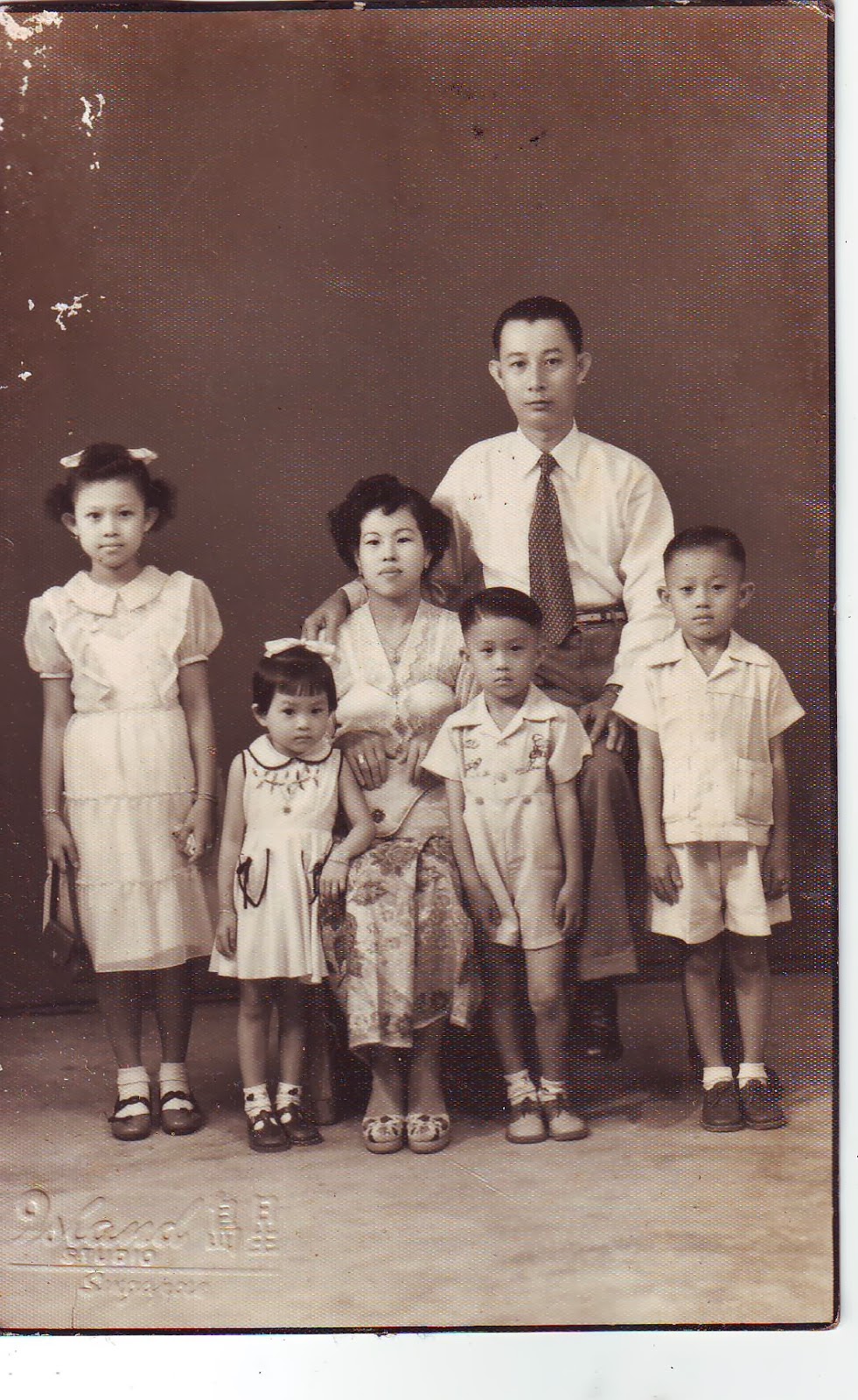
But Tahun Baru is not Tahun Baru without Uncle Joe Nee, Auntie Nelly and family.

The children are from left to right:  Rosie (my age), Pauline, Ah Pet (Patrick) and Bobok (Robert)
We would get a tray full of goodies every year without fail.  The four of us would demolish them within two days and then unashamedly hop over to their house and get more from Auntie Nelly and Tah Chi ( Auntie Nelly's mother).  At times, one of us kids would join Uncle Joe Nee, Auntie Nelly and their kids on  Tahun Baru visits to their friends and relatives.  What fun it was - filling up our bellies with cakes, and cookies and our pockets with little ang pow packets!  The packets were made up of gloriously red squares which were wrapped up so neatly with the dosh inside.  Of course when I got home and showed off my loot, Mak would take over and declare that it's to be shared with the other three .. YUCKS!

We often say of friends: "they live just across the road" - like Zarina and Ken and family at Setiawangsa.  But our Uncle and Auntie were unique - they were just across the river, the Sungai Nipah.  Whenever Mak wanted us to deliver food to them, one of us - usually me - would make the crossing.  Rosie or Bobok would do the same for us, from the other side.

Within the green box  our house is marked  brown and Uncle Joe Nee's is pink.  I have added the river (in blue) in the map.


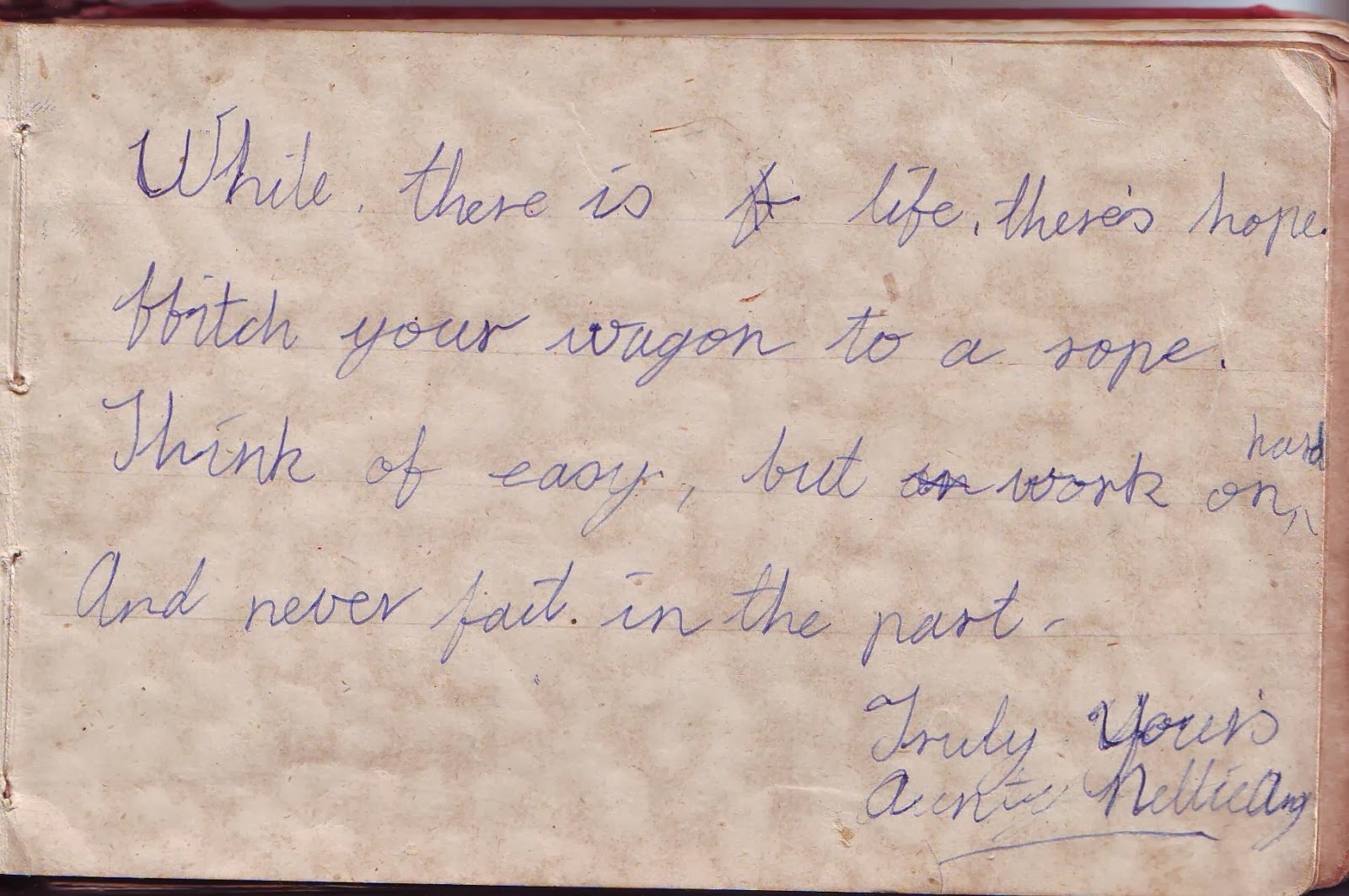
My sister Maznah, bless her cotton socks, kept and treasured her Autograph books.  And these gems from Uncle Joe Nee and Auntie Nelly - I have managed to scan.

From Uncle Tan Joe Nee


From Auntie Nelly Ang

Our two families were very close friends and I regret very much that we have lost touch.  I blame it entirely on us, the kids.  When we moved out to Jalan Mas Kuning and  Johor Baru and especially when my mum got older, from her mid-50s,  she often mentioned her wish to meet up with Nelly and Joe Nee.  Of course she would need our help, but we were always "too busy" !

We grew up with Selamat Tahun Baru for our Chinese brethren - not Khong Hee Fatt Choy or Gong Xi Fa Cai.

That was the Golden Age - an Age of good and honourable people, like I described in my posting on Tuberculosis, Teapot and Tears.  But you may say, we old people always romanticise the past.  That may be so, but at least we have that to keep a warm glow in our hearts.

 Much later - when I became an adult and a teacher at Jurong Secondary School, Singapore - I could hope for (and re-live a little) the way we were  and should be with these Rainbow Kids.

The mixed - salad kids circa late 1970s.

If only .......


SELAMAT TAHUN BARU - as I would greet Auntie Nelly, Uncle Joe Nee, Rosie, Bobok, Ah Pet, Pauline, Ah Chwee, Ah Seng, Kerani, Seng Teow, Ah Bok, Seng ............

Thursday, 30 January 2014

WHAT 'S IN A WORD? The Context of the "Allah Controversy" - The Final Part


This concludes Iain Buchanan's article from the previous posting:


(3)  The Malaysian Connection.  In a country as diverse as Malaysia, the use of culturally or religiously charged words is especially problematic.  After all, words are never neutral, they mean what we want them to mean.  So the intention behind the word is all-important - especially in such sensitive (and strategic) concerns as bible translation.  And especially in a context which involves so many known points of potential conflict - whether religious, ethnic, rural-urban, or regional; a context in which disparities  may interact and interweave in the most complex of ways: as evident, for example, in the status of East Malaysian Christian bumiputeras in a Muslim-majority federation.

Within this context, the Christian campaign for the use of the word "Allah", especially within a Malay language context, is unfortunate - in a number of highly sensitive ways, it stands as a metaphor for dissent and division, rather than tolerance and coexistence.  And it conforms to an evangelical message that too often seems hostile to Islam and Muslims, and (at the very least) designed to alienate Christians from non-Christians in a multi-cultural country.  This can be seen at two levels: first, in the highly ambiguous usage of the word, and second, in the political context of the campaign (including the relationship between Malays and non-Malays, and the relationship between Peninsular and East Malaysia).

Perhaps, given this dire state of affairs, there are a number of steps that evangelicals can take to restore a degree of confidence in their honour - and in their role as partner in the task of nation-building.

They can begin by restraining the zealots.   In modern evangelicalism, much of the zealotry revolves around people like C. Peter Wagner.    And in Malaysia (as elsewhere) the influence of C. Peter Wagner and his ilk is strong and growing - in large churches (of various denominations) such as Metro Tabernacle, Grace Assembly, City Harvest,  Sidang Injil Borneo (SIB), and Damansara Utama Methodist Church (DUMC), in an increasing number of smaller churches both in Peninsular and East Malaysia, and across a wide range of "secular" activities (such as business, education, and entertainment) - evangelization, it is worth remembering, is not just a matter of church prayers.

But Wagner and his friends don't have a monopoly on zealotry.  As active players in a global movement, Malaysia's NECF (National Evangelical Christian Fellowship) itself may sit beside some very dubious bedfellows - like Brother Yun, leader of the Back to Jerusalem Movement, who claims that his efforts may cost over 10,000 martyrs to the cause of evangelizing the Muslim world.  In 2005, Brother Yun's recruitment visit to Malaysia was enthusiastically sponsored - and later defended- by the NECF.   In addition, Brother Yun's main Western promoter, the missionary Paul Hattaway, now teaches in the Malaysian School of Cross-cultural Mission.
See:  www.necf.org.my/newsmaster.cfm?&menuid=2&action=view/retrieveid=579
See:  www.christianitytoday.com/ct/2004/april/5.84.html?start=2

If zealots are to be controlled (and trust between religious communities restored) it is people like Wagner and his cohorts, and Brother Yun, who need to be reined in.  Not, in the first instance, by the authorities.  No: above all, it is such people's co-religionists, their fellow-Christians, who need to take steps, in full public view, to clear the air.  After all, Muslims are constantly being urged to banish the zealots from their own stables; so this is not much to ask.  Perhaps, then, Muslims can begin to feel that there is nothing suspicious  about the use (by Christians of any persuasion) of any particular word.

Secondly, it may be politic for Christians to admit that non-Christians do have reasonable grounds for doubting their good intentions.  And this applies across all denominations, whether avowedly "evangelical" or not.   For in Christianity, more than any other religion, the line between what is evangelical and what is not is extremely (and often wilfully) blurred.  And furthermore, as the present situation shows, evangelical fervour can be a very cooperative virtue - uniting Catholic and Protestant, "evangelical" and "mainline", on matters of common strategic interest (such as the use of the word "Allah").  It may be wiser to show a little more tact, and a little more humility - rather than to hammer on about "victimhood", "state persecution", and "abuse of human rights".

For the reality is, in global terms, and in Malaysian terms, Christians are not victims.  That is not to say that many Christians, (or Muslims or Hindus or Buddhists) are not victims.  It is to say that, in terms of wealth, happiness, and personal safety, Malaysian Christians are certainly no worse off than their co-religionists in the West - whatever their mullahs try to suggest to the contrary.

And in this whole tangled debate, this is perhaps the most important fact of all.

Wednesday, 29 January 2014

WHAT'S IN A WORD? The Context of the "Allah Controversy"

There is no shame in not knowing, the shame lies in not finding out.  (Russian Proverb)

Many, many moons ago Iain Buchanan was my Geography Tutor at Singapore University.  Of course we had to write essays for him to read, analyze, scrutinize and assess.  We anticipated with anxiety Mr Buchanan's report and criticisms when our papers were returned.  We would always find about 5-6 lines of  comment - that is if you write a reasonably thoughtful essay!!

Now the shoe is on the other foot.  I've cornered him into writing AsH an essay on a very complex and fraught issue in an equally complex and fraught nation.

                                                  ==========================================

                             WHAT'S IN A WORD ?
  
               The context of the "Allah Controversy"

                               by  Iain  Buchanan


If the tussle over the word "Allah" teaches us anything, it is that words have great power for both good and harm - especially in the matter of religious faith.   Christian evangelicals certainly know this, which is why (among other things) the Christian Word Industry is as enormous and as well-funded as it is.   Evangelicals have been translating the Bible into native languages for centuries, so when it comes to manipulating words, they know only too well what they are doing.   Unfortunately, such people also have a lengthy track record of destroying (and at the very least subverting) non-Christian cultures - and using deception in the process.  So, in the wider world, it is understandable that non-Christians are suspicious of Christians when the words they use seem to be of ambiguous intent.

In the global media, the Malaysian authorities are naturally at something of a disadvantage: after all, the Christian freedom to worship is an especially glamorous issue at the moment, and there are plenty of big guns wanting a piece of the action.    So maybe we need to stand back and look at the issue a little more holistically.

In such issues, context is all-important.  Three elements of context seem especially significant here: first, the wider evangelical concern with "non-Christian" words - let's call it the "Christian Word" industry: second, the particular matter of evangelizing Muslims (and the use of the word "Allah"); and third the special complexities of the Malaysian case.  

(1)  The Christian Word industry.  Evangelicals, by definition, have a subversive agenda:  they seek to change how the rest of the world thinks and acts, to assert the hegemony of their own beliefs - and to do this at all costs, in whatever way feasible, through deception if necessary.

Indeed, deception is intrinsic to the evangelization process. It has to be, simply because people will always resist having their most fundamental beliefs destroyed.  And so to overcome this problem, among the many thousands of cultures that they target, evangelicals devised an elaborate programme of approach, penetration, and persuasion - in which deception is justified in terms of divine calling.


And in this crusade to change the world, evangelicals have a particularly potent weapon: they control the language of the entire campaign - they write it, translate it, manipulate it, publish, print, and distribute it on a global scale across every culture there is to be reached and through every tongue and every medium there is to be exploited.  In particular, they have scoured the world's  cultures, languages, and dialects for every local word, every metaphor, every expression, of "God", "Jesus the Son of God", "the Holy Ghost", "Mary",  and any other useable device which will help them to penetrate a target people.

In the process - and for a total of 7,000 linguistic groups and 10,000 cultures - evangelicals have built up huge data-bases of political, socio-cultural, economic, religious and linguistic intelligence.  For religious faith, after all, is a complex matter, deeply rooted in all aspects of being.  It is not simply semantics.  ( www.joshuaproject.net )

Not surprisingly, the evangelicals' "Christian Word" industry is enormous.  It comprises thousands of corporate and church bodies.  It is worth many billions of dollars, employs millions, and has the world's most advanced technology ( and sharpest corporate managers ) at its disposal.  It connects, seamlessly, Western corporate finance, advanced military grade telecommunications, neighbourhood churches in Texas (or KL),
tribal village missionaries in the Himalayas (or Borneo),  Bible publishers in China, University linguistics departments, and a hundred other activities.  It is everything from the tract in a hotel drawer to the solar-powered Bible pack in the Bangla Desh borderlands.  You take on the Christian Word industry at your peril.

See: http://haughherald.org/2011/03/28/4th-wave
(click link and go to "Accelerating Bible translation wit....."at bottom left hand).
        
See: www.economist.com/news/china/21574529-china-has-become-one-largest-producers-bibles-world-beginning-was

See:  www.sil.org/resources/search/contributor/hurlbut-hope-m


(2)  Evangelizing Muslims.  The Christian Word industry serves a number of very strategic and very clearly defined objectives.  One of the most important of these is the subversion of Islam.  Of course, being in control of the language, the evangelicals would not put it quite like this - at least not in public, and certainly not amongst Muslims.  Most evangelical public speakers, and most evangelical NGOs would vehemently deny such a motive.  They would prefer the rubric of "mutual respect"  and "peaceful coexistence", dressed in the emollient phrase, the smiling assurance, the earnest plea; they would prefer to disarm the opposition with words.  The record shows a rather different picture.

For decades, the evangelical movement has been engaged in an energetic and systematic campaign to undermine both Islam's spiritual power and its political influence.  From the 1970s, Western Christians launched what was effectively a second reformation of the global church.  The Lausanne Movement, strongly inspired by Billy Graham, Fuller Seminary, and groups like World Vision, set up a series of  "consultations" on key evangelical concerns, including the mechanics of culturally  "contextualizing"  the gospel, and the business of Muslim evangelization.

The Muslims were dealt with most comprehensively in the 1978 Conference on Muslim Evangelization, co-sponsored by Fuller College (and its offshoot the US Center for World Mission)  and World Vision, and held in the Glen Eyrie headquarters of The Navigators.  The official account of this conference ( www.lausanne.org/en/documents/lops/75-lop-4html ), of course stressed mutual respect and friendly persuasion.  But the subversive intent was abundantly clear.

For the next thirty-five years, the West directed a combination of "hard" and "soft" power against the Muslim world, and the evangelicals' strategic interest in the matter grew accordingly.  This interest is both profound and globally articulated, as two recent developments - the launching of Operation Samaria from Nigeria and the re-invigorated Back to Jerusalem Movement from China - amply demonstrate.

Read: www.lausanneworldpulse.com/worldreports/361?pg=all
Read: asiaharvest.org/wp-content/themes/asia/docs/newsletters/99-May2009-BacktoJerusalem.pdf

Christianity (of western origin),  Chinese Christian Church and their potential(?) harvest of Malay- Muslim children.

These are just two examples of a well-coordinated push against Islam, promoted by a cross-section of Christian denominations ( from Catholic to Pentecostalist ), and defined by a mix of evangelical fervour, political imperative, and wholesale deceit.  Key to the entire process is the work of thousands of "Insider Movements", operating within the theory of the "C1-C6 Contextualization Scale".

C1 - C4 Contextualization Scale.  Malaysia would be included in C1 and C2 and C3.

C5 -C6 Contextualization Scale

See: http://www.ijfm.org/PDFs_IJFM/21_4_PDFs/Key_Insider_Higgins.pdf
See: www.stfrancismagazine.info/ja/images/pdf//6PhilBoureSFM5-5.pdf
See: www.xenos.org/ministries/crossroads/OnlineJournal/issue1/contextu.htm

It would be naive to pretend that  Muslim evangelization is not a vital concern for Christian evangelicals  And it would be naive to believe that the evangelical use of Islamic or Arab terms is rooted solely in some local expediency.  There will always be a wider socio-cultural, and political,  context for the definition of such words.  So, in the present context, when Christians use a word like "Allah", do they  mean what Muslims mean by the term - in all its theological complexity, with all its cultural and political ramifications?  No, of course they don't.  They mean something that is theologically very different -  not least in its association with the various Prophets (which, after all, is what so distinguishes Islam and Christianity); they also mean something with very particular cultural and political connotations.  And crucially, they can mean various things: from God the Creator to the Devil himself.

Theologians, anthropologists, and linguists will argue endlessly over such matters, no doubt.  But the meaning of a word is all-important - certainly more than its form or sound.  After all, we can be sure that the Kadazan word for God ( "Kinorohingan") meant very different things to a pre-Christian villager and to a convert reading the word in the Kadazan Bible - which, let's face it, is anchored in a totally different cultural world to the pre-Christian village, whatever evangelical "contextualizers" seek to pretend to the contrary.

It is the same with the word "Allah".  Do evangelical Christians really mean what Muslims mean by the word?  Of course not: if they did, there would be no need for evangelism.  For one thing, there is more than a world of difference between the Oneness of the Muslim Allah and the Trinity of the Christian God.  But there is more to it than this.  Consider the words of one of evangelical Christianity's most influential leaders.

In his definition of "Allah",  C. Peter Wagner is categoric:  Allah, he says, is "a high-ranking demonic spirit who has come to steal, to kill, and to destroy."
Read:  www.chpponline.blogspot.co.uk/2007/05/c-peter-wagner-some-thoughts-on-iraq.html

"Allah," says Wagner, "is the proper name of a spirit being .... he is no more God than is Wormwood or Beelzebub or Apollyon or Shiva or Baal or Lucifer.  All of them are beings created by God, but who ended up agents of Darkness, just as Satan did."

Muslims, by definition, are damned:  "Those who do not believe in Jesus,"  says Wagner,  "including those who worship Allah, are destined to spend eternity in hell."
Read:  ojs.globalmissiology.org/index.php/english/article/view/65/193

And Dr Wagner sees his own role ( and that of his followers) as decisive in opposing such a state of affairs:  "God has (entrusted) to us the most challenging assignment ...... the Muslim people of the world, starting with the fifteen nations of the Arab Middle East ... Our sphere also includes the non-Arab Middle East, the Muslim nations outside the Middle East, and the Muslim Diaspora."

"God wants us to start governmentally, connecting with the apostles of the region ....  Once we have the apostles in place, we will then bring the intercessors and prophets into the inner circle, and we will end up with the spiritual core we need ... for retaking the dominion that is rightfully ours."
Read:  www.herescope.blogspot.co.uk/2005/11/c-peter-wagner-on-taking-dominion.html

Of course, not all evangelicals share Wagner's perspective. But a great many do: C. Peter Wagner is a man of enormous influence - and not only  amongst his own Pentecostalists.  Professor of Church Growth in Fuller College, Wagner was also head of the Lausanne Congress on World Evangelization's Strategy Working Group.  As the process of Muslim evangelization evolved and accelerated, the role of C. Peter Wagner grew more influential - especially after 1990, when the emphasis on "spiritual warfare" took over much of the evangelical movement.  Indeed when Wagner opened his World Prayer Center in 1998, it was likened to "a spiritual version of the Pentagon", with Wagner himself playing the role of  "the Church's Norman Schwartzkopf."
Read:  www.deceptioninthechurch.com/wagnerquotes.html

As evangelicalism becomes ever more infected by the zealots of "spiritual warfare", Wagner and his lieutenants  (including Chuck Pierce and Cindy Jacobs) came to dominate much of the Christian agenda.  Wagner formed a clutch of institutions to frame his evangelizing effort  - Wagner Leadership Institute, Global Harvest Ministries (1991), World Prayer Center (1998), International Coalition of Apostles (1999), and Apostolic Council of Prophetic Elders; just as significantly, he and his officers formed links with a wide range of other evangelical groups, usually with common ties to Fuller College, World Vision, and the Billy Graham network - and all firmly anchored to the Lausanne evangelical process.

In other words, Dr Wagner emerged as a kingpin in a diverse, tightly-organised, and global effort of subversion - directed from the heart of the evangelical movement, against all non-Western cultures, but especially against the Muslim world.  Above all, Wagner and his many acolytes and proxies shape much of the perception that Christians have of non-Christians - and define much of the language which expresses this.

So, what does this mean?  First and foremost, it means that in the hands of Christian evangelicals, words like "Allah" (or "surga" or "perintah" or "Kinorohingan") are not only convenient biblical devices - they are also potent cultural and political creatures, of variable meaning.  They ramify very tightly, and very significantly, with the social, cultural, and political context of their use.  And the evangelical mullahs know this.  Religious faith is a complex cultural matter; it is also an intricate (and very influential) political matter.  It would be disingenuous to pretend otherwise.  And it would be naive to imagine that, in many an evangelical context, words are not also used as weapons against their rightful owners.  After all, as Dave Cashin, Professor of Intercultural Studies at Columbia International University, said: "We must become Muslims to reach Muslims."

Herein lies the problem.  It is not so much a problem of semantics and etymology; it is a problem of intentionality, a problem of niat.  In the present dispute this seems to be the most important factor of all.  And it has to be said: when it comes to a clarity of intention, Christian evangelicals have a pretty bad track record.

( The third element of context :  The Malaysian Connection, will be posted tomorrow.)
Wednesday, 22 January 2014

The Camel and the Arab - a metaphor for the Allah Issue


One day, an Arab and his camel were crossing the desert.  Night came and the temperature became colder.  The Arab put up his tent and tied the camel to it, then went to sleep.  The temperature became slightly colder  and the camel asked the Arab if he could just put his nose in the tent to warm up.  The Arab agreed, but just his nose, because the tent was small and there was no room for two.

Christianity or rather  Roman Catholicism came to the Malay Peninsula with the invasion of the Muslim Sultanate of Malacca by Catholic Portugal in 1511.  In the late 1400s the Christian kingdoms of Spain, Portugal, Britain, France, the Netherlands were stretching their sea-legs across the Atlantic to the Americas, Africa, India, China and Japan and Southeast Asia  sniffing around and searching for spice and trade and souls to convert.  Portugal  became the foremost maritime power especially after Vasco da Gama's success in crossing the Cape of Good Hope with ... shhhh ...  the help of Muslim navigators who were familiar with the Indian Ocean and the east coast of Africa.

The Catholics, unlike the Protestants of later times made no bones about their agenda of  'saving' the souls of the pagans by converting them to Catholicism.  In fact St Francis Xavier - a co-founder of the powerful and influential Jesuits, heard of the Malay Archipelago ......


The Malay Peninsula and Sumatra from  a Portuguese map.  North is to the left of the image.

...........after the conquest of 1511  and decided to evangelize and harvest more souls from among the Malays in this region.


Extract from Story of Malaya by W.S. Morgan, 1956


Count  the number of Churches in  the Fortress of Malacca.  I note about five.


Statue of St Francis Xavier, patron saint of Catholic Missionaries, at St Paul's Church, Melaka.

If not for the imperial ambition of the Protestant Dutch, who, with the aid of Johor defeated the Portuguese in 1641, the Peninsula could have been  another Catholic success story like Goa and the Philippines.  Who knows?  We could have been  re-named Albuquerqia or San Francisca or DaGamaland???


The exploits of Catholic Portugal 


So, the camel's nose became warm and after a while the temperature went down even further.  The camel asked the Arab again if he could just put his forelegs in the tent because they were very cold.  The Arab reluctantly agreed - that the camel could only put his forelegs in and no more.

And so it came to pass :  the entry of the camel's forelegs was not  unlike the Western-Christian foot at the Muslim-Malays'  door.  The Malay Archipelago became a huge prosperous playground for the Imperialists, both Catholics and Protestants.  "He who dares, wins" so to speak.  (This is the motto of the British SAS as well as Del Boy's - the cockney wideboy in my favourite comedy  " Fools and Horses").


So the camel moved in his forelegs.  They soon became warm.  After some time, the camel told the Arab that he had to put in his hind-legs or else he wouldn't be able to make the journey the next morning because his legs would be frozen. 

So,  the  encroachment of the the 'hind-legs' of the Christian West followed soon after.  And the imperial scenario expanded far, far beyond the agenda of the Catholic Spanish and Portuguese.  


That speaks volumes!!  From "The British Empire" by BBCtv Time-Life 

The Arab agreed.  But once the camel moved his hind-legs in, there was no more room in the tent for the Arab and the Arab was kicked out.

The moral of the story?  With the permitting of what seems like reasonable, innocuous acts, the door is flung wide open for larger, undesirable demands. 

The intrusion of the camel's hind-legs into the Arab's  tent is not much different from the insistence of  Christians in Malaysia to requisition the word Allah.  This could only lead to dissension and fractures in the fragile political structure.  Malaysia is not a homogeneous society.  It is made up of too many divisive elements created by the politics and machinations  of  the Imperial Christian West.  The tent is too small. The "Arab" made the mistake of succumbing to the camel's threats of  being "unable to make tomorrow's journey."  Malaysia must not and cannot comply like the Arab in the fable.  

                                            ===============================
As it stands, since 1786,  the camel from the West has got its  nose, forelegs and hind-legs firmly entrenched in the Malay Peninsula's tent.

It was not enough that Christians thrived and prospered in a Malay-Muslim domain.  Under the umbrella of the Christian Imperial Rulers, they had their way mapped out for them.  They could spread their gospel,  build their churches and Cathedrals and graveyards where they wanted.  Their Christian schools were generously endowed by the Colonial authorities.  Although they were in the minority, their festivals like Easter and Christmas were given equal billing with those of the majority Muslims.  Even Sunday, their Sabbath day, was gazetted as a the day off for each week so that they could attend  Mass and Services at  their Church.  As for the Muslims - especially in the Federated Malay States and Penang - well, they just had to sort out and make their own space and time for their 'Sabbath Day', for Friday Prayers! That, of course, is also the routine here for Muslims in Britain.  But then they are not the Bumis of Britain.  Britain has a Christian culture and Muslims do not make the majority of the population.  So Muslims in Britain had to go with the flow of British ways and purpose.  They do not, they cannot, challenge and claim the same  privileges that the non-Muslims enjoy in Malaysia. 

The adamant campaign for the appropriation of the Arab word for God is a very clever and subversive device to turn Christianity and Christians in Malaysia into victims.  This is but a  part of the grand design to spread the gospel ever more widely - and paint the Malay-Muslims into a corner at the same time.

During the era of Western  Imperialism,  Christian missionaries in Asia and Southeast Asia were almost always white men and women.  In those early days the white man  carried an aura of semi-divinity, power and respect in the eyes of the natives - the Tuan and Mem. Today, the tactics and strategy are changing.  Take this innocent little report from our Leicester Mercury in 1989. 


Note the part underlined in red.
Non-white recruits are now the "blue-eyed" messengers of the Gospel. They have the ability to merge easily into the catchment area of the evangelists and  unlike  White missionaries they do not stand out like  sore thumbs and their presence, whether overt or covert, don't set the alarm bells ringing.

In 1986 we came across this little gem in a Christian paper "Challenge Weekly"  in Wellington, New Zealand.


Mr Steve Oh, an evangelist and director of Asia World Mission was keen to encourage New Zealanders to spread the Christian message because  "it is possible under Malaysian law to evangelise, but it must be done sensitively".  Somehow I reckon their interpretation of 'sensitive' is more akin to surreptitious 

The 'sensitivity' referred to by Mr Steve Oh is not about respecting the Muslims and Islam. It's about selecting the right tactic  -  "I would strongly caution against cold turkey, cold contact street evangelism in Malaysia".  

I find it quite amusing that non-Malays in Malaysia who are not too keen on using Bahasa Malaysia in education and day-to-day communication are not averse to utilising it for their Christian tracts, pamphlets and the Bible itself.  One can see why.  There is Indonesia, a huge Malay-speaking world that is ready for the picking.

When the Catholics in Malaysia spearheaded the crusade for commandeering the Arab word Allah for their own,  I cannot help but reflect how Mr Steve Oh's 1986  statement about evangelising in Malaysia was in fact quite prophetic.  He cautioned evangelical groups to  'pay more attention to contextualising their evangelism' . 

Indeed, in an arena such as Southeast Asia, you can't find a better context than to appropriate the word "Allah" - which is at the very heart of  the terminology of  Islam and the Koran - with which to dress up Christian evangelizing.      And the evangelists know this very well.

Christian missionaries in the past have been very imaginative and creative in persuading and 'saving' pagans and non-believers for their cause.  Here's a fascinating example of how they turn the language of their target community to fit into their crusade.


The original caption of the above reads as "The Nigerian Pidgin (a Chinese corruption of "business") in this catechism was one of several Pidgin dialects used in converse with natives."


(The text of the fable was taken from the video by itsaperfectstory.  Thank you.)


Finally a little proverb.  A SOW MAY WHISTLE, THOUGH IT HAS AN ILL MOUTH FOR IT.


Saturday, 11 January 2014

Colin's Fault

The Moon, with Jupiter , a little dot just to the northwest.  Seen from our front door on 21.11.2013 at 2330 hours - thanks to Colin who pointed them out to us.


Colin came for dinner and when he departed for home he left  us the vision of the moon and Jupiter - in the sky, in our spirit and in our heads.  He also got me hooked on watching out for Comet Ison  (both the real thing and on the Astronomy Websites) which was supposed to be visible around 3 December.  On 11 December 2013, ISON was pronounced dead - that it did not survive its encounter with the sun.  But there's hope that fragments may have survived.


The first video gives a description of the arrival of the comet and the second is interesting for comparison of size and sightings of the comet in November.

Now if I had got to be this keen on stargazing and comets when I was 16, I might have turned out very different -  female Malay  Astronomy Geek instead of female Malay malcontent.  But as Colin puts it,  "You're never too old to learn"  The trouble is, when I was 16, Colin would just be a snotty kid of 6!!

As if that was not enough, Colin tempted us with an evening of Stargazing at University of Leicester on 8 January 2014.  We applied and we managed to get our places.  Of course Mr Colin Brooks, Chief Photographer, Creative Services, External Relations, University of Leicester encouraged these two geriatrics with a beautiful skymap to be used for the evening - made by the young man himself!

www2.le.ac.uk/institution/stargazing-live/event-documents/360-star-map

Here's a list of the activities for the evening.
www2.le.ac.uk/institution/stargazing-live/event-documents/welcome-and-activities-list-programme

AsH admits she has been guilty of truanting on the usual ramblings because she's been too starry-eyed, so to speak.  She has literally gone over the moon  with these two photographs of the moon taken in the backyard.

The Moon on 21 Dec 2013 at 0732.
The Moon on 25 Dec 2013 at 0731
In the span of 4 days the moon has moved further to the left of the photo - to the east.

But, above all, a few words about Colin.    Colin has been University photographer for over 40 years.   But Colin lives and works in a box far far bigger than his job.   He is an amateur astronomer, a musician, a lover of maps, and an all-round technical whizz kid.   He has a love of life and all its mysteries.   And that wholeness of vision is what inspired these two old cynics to look at the stars, seriously, for the first time in their lives.  He's a gem.  He must have arrived on earth via a meteor fragment!

And so let me end  with these two poems - in Malay and English - on the moon, extracted from two 1950s/1960s school textbooks.


Tuesday, 31 December 2013

Ilyas and Emir and the Archbishop

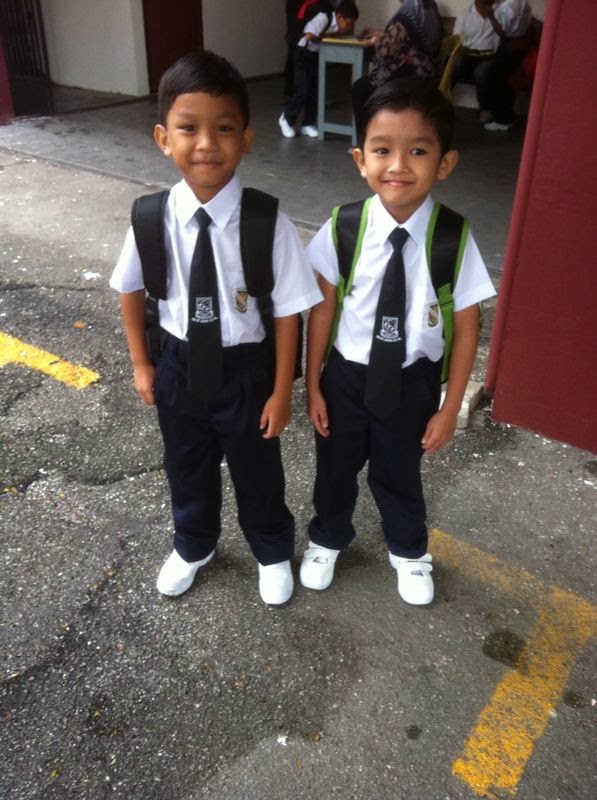
Got a much needed ray of sunshine when Abang Long, my brother-in law, sent me this photograph of his "Cucu No. 8 and 9" on their first day at school.

Ilyas (on the left) and his cousin Emir all geared up to face the world of learning - for the next  12-15 years.
I know my sister will  thump me for showing this : Tok Wan in Primary 1 circa 1949.


Maznah first went to St Anthony's Girls' School  (top photo) when we were living at Kampung Chantek, Dunearn Road. The family then moved to Kampung Abu Kassim at Pasir Panjang Road and she had to have a change of uniform for Pasir Panjang English School.

Though Tok Wan looked like a frightened rabbit during her first year in school, her grandsons are full of smiles and confidence.  Could it be because they are wearing long pants and not just shorts?  In the old days long trousers were only for the big boys in secondary school  (except for Jurong Secondary School, Singapore).  Little squirts in primary school were only allowed shorts!  But then little boys (and big ones) are good at hiding their fears and their mischief.  They may look like butter won't melt in  their mouths but they do have a remarkable, innate talent for driving you up the wall and round the bend.

It wasn't too long ago when they were just two little nuisances and a pain in the ears!

Dennis the Menace and Roger the Dodger in 2008
Thank you Bang Long (and Maria) for keeping me in the loop - and for giving me a kickstart to get on with writing.  Most of the time for the past few weeks my head had been feeling  like this spinning carousel at Leicester City Centre.


I put it down to these series of medication (not the book though) - three so far - for a geriatric blogger with a dodgy pulse rate.


On the other hand, the fatigue and breathlessness could be due to a deficiency of sunshine, blacan and sambal pedas petai/ikan bilis?

Elyas, his old man Nadzim, his big brother Ariff, and Emir are privileged to have attended  St. John's Institution or Sekolah  Kebangsaan St. John, one of the oldest schools in Malaysia which was opened by the La Salle Brothers in 1904.  For more information, check   http://malaysiafactbook.com/St._John's_Institution,_Kuala_Lumpur

This Catholic missionary institution has developed in tandem with the country's post-Independence education policy designating  itself as Sekolah Kebangsaan St. John without the letters 'Ç' and 'T' in brackets.  In 1969 St John took pride in organising the annual English and Bahasa Malaysia public speaking competition.  "Public speaking became part of the English and Bahasa Malaysia curriculum and was compulsory for all students".  St. John maintained its Christian heritage and autonomy in management even though it has become very popular with non-Christian students and their parents - making it a multi-ethnic and multi-religious Sekolah Kebangsaan.  "Though the school land is owned by the Roman Catholic Church .....  much of the school funding is received from the Government of Malaysia".

In May 2010 it was declared a National Heritage Site by the Ministry of Culture, Arts and Heritage.  It was one of the first schools to be recognised as a Cluster School of Excellence where it was granted autonomy in   'administration and adequate funding to excel in specialised fields such as academic, sports and extra-curricular activities".  St. John can be proud of two other aspects of their CV.  They provide for visually-impaired students who attend normal classes like the other students.  They are taught by specialist teachers and given extra tuition by student-volunteers.  Also this school is blessed with generous contributions from former students and other benefactors together with a dedicated Staff and PIBG.  If only other Sekolah Kebangsaan in the country could replicate the dedication and standard  of Sekolah Kebangsaan St. John.

Like any other parents, Maria and Nadzim, Hidayah and Faiz - the parents of Ilyas and Emir respectively - wanted a school where their children could thrive and grow - in  Bahasa  Malaysia and English -  in both the academic and non-academic spheres.  Their other priority is that their children should study and grow up with other  (non-Malay) Malaysian children.  In the classroom, in the canteen, in the playing fields, their children together with others who make up the Malaysian rakyat,  will get the opportunity to work as a team, to quarrel and bicker as children do, to share and compete, to laugh and cry together and most important of all - despite their differences in skin and faith - they will  learn to respect - and not to just tolerate - one another

And so I was quite distressed when I read this in The Malaysian Insider on Christianity's most holy day.

See :   http://www.themalaysianinsider.com/malaysia/article/archbishop-packiam-prays-that-the-pm-will-remember-where-he-came-from

Here's an extract with the most telling parts marked in green ......

  
And so it came to pass that on one Christmas Day, a day for "peace on earth and goodwill to all men", Archbisop Emeritus Murphy Packiam  decreed that .......


Is this payback time because a Muslim boy studied in a Catholic school?  What about non-Muslims who live and prosper in a Malay-Muslim Semenanjung and Southeast Asia?   In fact, Catholic and Protestant/Anglican/ Methodist Missionary schools, vernacular Chinese and Tamil schools  have thrived much more than Malay schools from the time of the invasion of the Malacca Sultanate by  the Catholic Alfonso de Albuqurque in the early part of the 16th century - through Dutch and especially British Imperialism and right up to 1957.  With such generous support and handouts from the Colonial Government it is rather the  Christian Mission schools who should show gratitude to the  natives for letting the Christian white overlords to act as they please in the Semenanjung for their benefit.


What can I say?  Big deal!  For this semi-divine favour, should Tun Rahah be obliged to instruct her PM son to forego his responsibilities to the rest of the country and give  Archbishop Packiam  his perceived "pound of flesh".   It seems that the Prime Minister of Malaysia owes him ( and his cronies) a helluva debt!  Does that also include all the Malay-Muslim children, past and present, who attended Catholic and other Christian schools?

O mighty Caesar! dost thou lie so low?
Are all thy conquests, glories, triumphs, spoils
Shrunk to this little measure?     (Shakespeare : Julius Caesar , III. i. Ib.148 )

But I do believe that this school where my father's great-grandchildren will spend the next 12-15 years of their lives does not subscribe to the same ethos as the good Archbishop.

However I think we should also consider another aspect of the Malaysian Insider's title, "... that the PM will remember where he came from".  It is crucial that we must not forget to remember how we got to be Malaysians and how we got to be where we are now - and that includes Prime Ministers and Archbishops.

                                        ***********************************


This song by that true-blue anak Malaysia Andre Goh,  has accompanied me (via a cassette tape) wherever I wandered away from my shores.  It kept me company when I was in Brunei, as an anak dagang mencari rezeki di negeri orang, as a student in London, Colchester and Leicester and as the spouse of Donald Iain Buchanan in Leicester.

Bahagia lah dikau di merata negeri,
Jangan lupa asal mu tetap sejati.

And so for Emir and Ilyas,  one day, perhaps in the 2060s when you will reach my age, you will remember to hold dear your family and especially the two lines above.


Tuesday, 17 December 2013

Foot in Mouth Disease - Part II

This posting is dedicated to each and everyone of my Followers - with much appreciation for your support.

                                 ******************************

Last night some one took a potshot at AsH.  Because it was located at a remote corner of my previous posting "Whither the Malays  and Wither the Malays?"  ( See the Sidebar)  I decided to do a posting and give this cyber-warrior the oxygen of publicity.

This was the comment from AK47.


   And this was my "response" - short and sweet compared to the first Foot in Mouth posting.

Read :  http://anaksihamid.blogspot.co.uk/2013/04/foot-and-mouth-disease.html


To add meat to AK 47's angst over 'decapitated craniums of bovines'  I suggest he look up my posting "For Jagdish" 2 September 2009.
 Check   http://anaksihamid.blogspot.co.uk/2009/09/for-jagdish.html


Ahem.... sorry to be a bit finicky.  A cranium is just the bony framework.  Those idiots - in 2009- decapitated the head and the cranium within - of that innocent cow!


Bertepuk tangan, amboi tangan, tanda berani.
Tiada gentar, ala sayang, hai membela diri.