Wednesday, 30 October 2013

Sekolah Menengah Yusof Ishak - In the Beginning

I did an earlier posting on the school bearing the name of Singapore's first and (so far) only Malay President just about 2 months ago ....  http://anaksihamid.blogspot.co.uk/2013/09/the-yusof-ishak-years-preamble.html .  But I think I did too much ambling with the preamble.

My thoughts about the first school I taught in, about the first set of students that I was responsible for, about my first encounter with colleagues (teaching and non-teaching), about my first job at 23 after University, were all too complex and difficult to relate.  It's like recalling a first marriage, full of hopeful happiness ......

Rookie teacher in the Art Room of Sekolah Menengah Yusof Ishak, 1967

....... but it ended like in  P.Ramlee's song :  Ku sangka panas sampai kepetang, tetapi hujan ditengah hari.


In 1968 during my second year as a rookie teacher , I was given an extra-curricular duty that most teachers avoid like the plague.  Koh Sei Hian and myself were the only graduate teachers in YISS and the old guard in the school reckoned that these two must be made to jump the hurdles and  climb the ropes - just to teach them a lesson : nudge, nudge, wink, wink???   We were given the onerous task of producing the School Magazine. It involved having to organise articles from the students and getting reports from the teachers running the school's various activities.  These two jobs were comparable to extracting blood out of stone. Then we had to go with begging bowl in hands to extract donations and advertisements. I learned how to grow a thick skin while doing that.  Choosing the printers and supervising them (and the cost) needed the executive skills of a CEO.  Arranging the photo sessions for the Staff, all the classes and all the School's activities for the morning and afternoon sessions required the dedication and tenacity of a sheep dog rounding up a flock of errant sheep in the wilderness of Wales. 

When the Magazine was finally produced we were  bombarded by tetchy queries like "Why didn't you do this? or that?  What a lousy photographer! The students' articles are hopeless - can't you get better ones?  The printer must have cheated you - it's such poor quality paper!" Blah! Blah! Blah!  Koh Sei Hian and I did this thankless job for year after year until one year I decided to join the Army and run the Girls' Unit of the school's National Cadet Corps (NCC).  

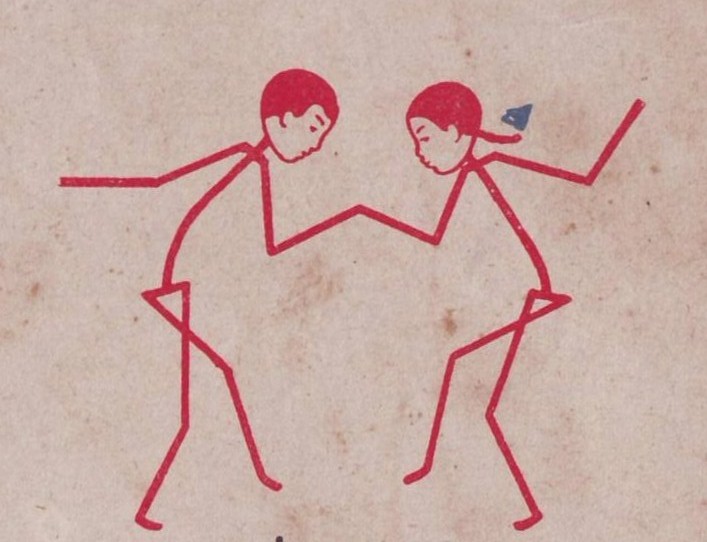
Below is the 'dummy'  cover of the 1968 school magazine JASMANI ....


....... and the members of the Editorial Board.
The Editorial Board 1968.  Seated from left to right: Che'Gu Maznoor and Che'Gu Shukur (Senior Assistant Malay Medium)  representing the Malay Medium,  the Principal Mr Charles Lazaroo,  Mr John (Senior Assistant English Medium) and Mr Koh Sei Hian from the English medium.

I liked the starkly simple design of the Cover,  the 'Jawi" font  and especially the two 'lines'  above and below the title.


That design incorporated the structure of YISS.  It began in 1965 as Jubilee Integrated  Secondary School, comprising of the Malay and English mediums.  It was tucked in between West Coast Road, Jubilee Road and Upper Ayer Rajah Road.  In 1966, the then Prime Minister Mr Lee Kuan Yew officially opened Yusof Ishak Secondary School - a more respectable designation than the run-of-the-mill  Jubilee Integrated Secondary School.  

In terms of  the development and demise of Malay education in Singapore, the context has to be understood. During the Colonial period, education  was never planned to be a leveller - as a means of improving the life and fostering the unity of the so-called "multi-racial" population.  Education in English was provided by the Colonial Government with the 'co-operation' of Christian missionaries. Their function was to oil the machinery of the Empire and as a bonus, especially for the latter, to enlarge the Congregation.  The Chinese mercantile community had always been very regardful  and supportive of Chinese education.  They were willing and able to put their money where their mouth was.  All for the tong pao.  The 'graduates' from  Chinese schools faced no problems in getting gainful employment because of their community's domination in Singapore's economy.

Education in the Malay language was never regarded with much seriousness by the Colonial Authorities other than to perpetuate the Malays' ghettoization in the unprofitable, primary economic activities like farming and fishing as can be seen in their curriculum.  In 1959 in Singapore, there were only 26 Malay primary schools and the highest level was up to Standard VII.  "Graduates" from these Malay schools ended up in the lower levels of the administration - as peons, soldiers, police and postmen.  In the private sector they were mainly  employed as drivers, gardeners and servants for the upper and middle-class European  and Chinese employers.  Although there was a request for the provision of English language lessons way before the Second World War, the Colonial authorities did not oblige until after the War itself.

As a matter of interest, the Colonial Government gave a grant of $30 per pupil  for the English schools.  In the Malay schools, it was only $17 per pupil!  We hear a lot about the massive contribution of  Christian Mission schools to education in Singapore and the Peninsula  but it should be noted that their collaboration with the Imperial Order was well-rewarded.  They were generously subsidized and granted a hefty leg-up by the British Colonial Government to the tune of $30 per pupil.

My career as a teacher began in Sekolah Menengah Yusof Ishak  in 1967.  From  Primary 1(1951) to University I was educated in the English stream, quite a rarity for a Malay, especially a female.  My exposure to learning my mother tongue in Primary and Secondary School  was very limited and sometimes non-existent at all.   Yes, I took the Examination for Malay language during my Senior Cambridge - and I got a mere Pass at S7.  I'm not too proud of that today but in the 1960s, Mathematics, English Language and Literature, Physics and Chemistry took priority.  After all, my preparation for my Senior Cambridge Malay Language paper began only in the latter part of  Secondary 4 (Form V).  We Malay girls from Crescent Girls' School were directed to a weekly class at Gan Eng Seng Secondary School on a Saturday afternoon.  We met up with other Malay pupils from several English schools who were in the same boat as us.  For my first Karangan we were told to write about any topic we wanted.  So my title was Darihal Kuching!    

Six years later, I was given a simple idea on how to teach in Malay.  This time it was Darihal Rokok.

That will be in my next posting.


Wednesday, 16 October 2013

The Canonisation of Lim Chin Peng - Blood or Ideology?

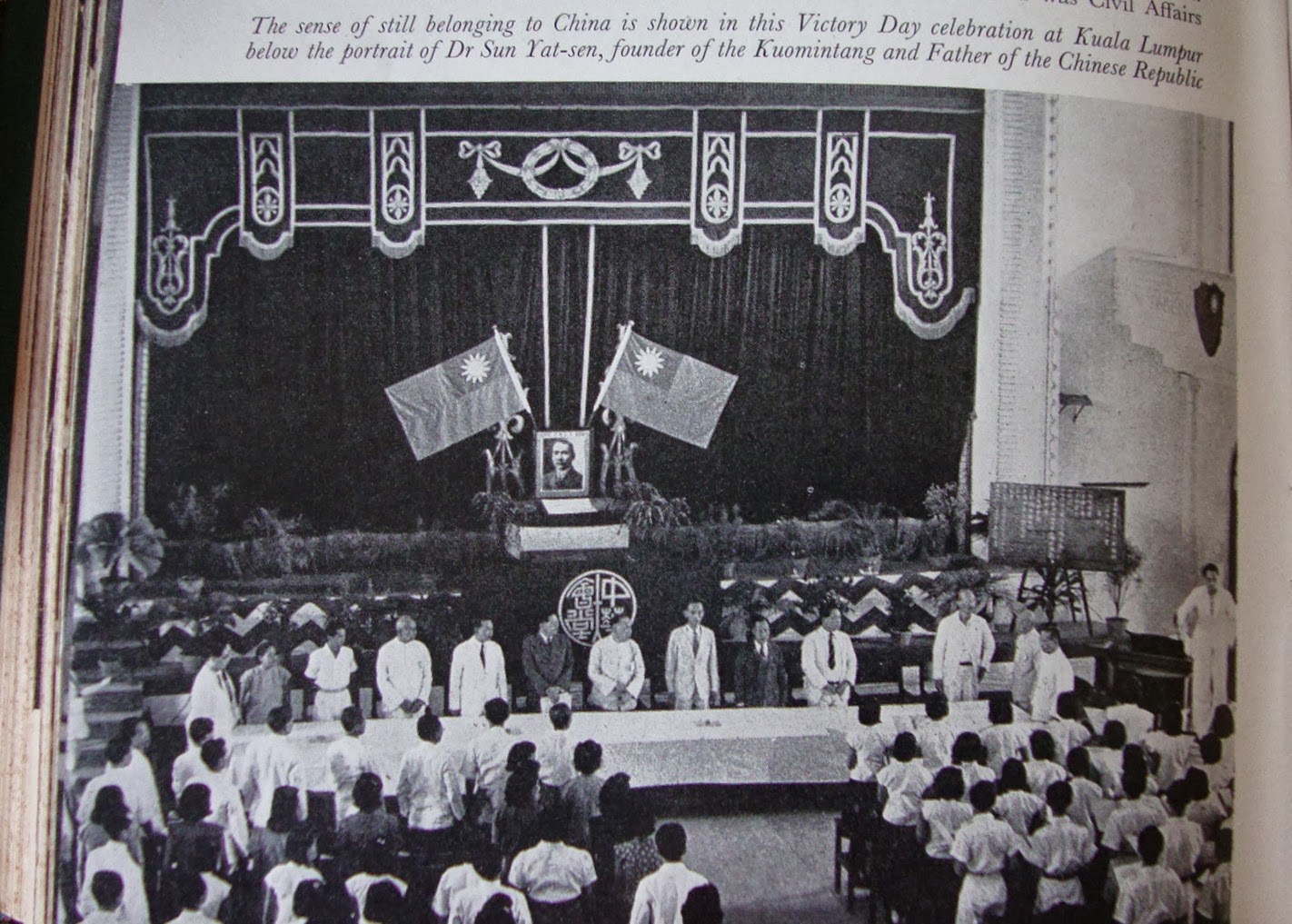
"The sense of still belonging to China is shown in this Victory Day celebration at Kuala Lumpur below the portrait of Dr Sun Yat -sen, founder of the Kuomintang and Father of the Chinese Republic."


A commemorative plate to celebrate V-Day.  The spouse bought this in a shop in Chinatown Singapore in1987.


Now that I'm at the cusp of my seventh decade, and having started on a regime of pill-popping after  breakfast, lunch and dinner, I thought I'd give myself a break and take a sabbatical leave from writing.  So, I looked up my embroidery books, my boxes of silks and aida fabric with the idea of getting back to a more placid domestic activity like sewing.

I'm still bemused by a comment made a couple of years ago by someone (obviously a male) who was  so narked with me for challenging his opinions that he ordered me to get back to my wifely duty of ironing my husband's shirts!  But AsH doesn't do ironing.  At least not shirts.  Instead she got tempted into ironing out crooked thinking - after she'd caught sight of an obituary on General Vo Nguyen Giap  in the Guardian, 4 October 2013.  Why?  Because it reminded her of Giap's contemporary Lim Chin Peng who'd died just a month earlier - and the question of context.

Giap (1911-2013) was a lawyer trained at the University of Hanoi.  "As a child," said the obituary, "his sense of nationalism had been nourished with stories of heroic Vietnamese generals and their victories against the Chinese and Mongols".  He was a brilliant general, "well-versed in Marx and Mao Zedong's writings on guerilla warfare".  But he often said, "We fought our wars in a Vietnamese way.   My only influences were the great strategists of Vietnamese history". Together with Ho Chi Minh, with the support of the Vietnamese Kinh, largely regarded as the 'standard Vietnamese'  identity, Giap orchestrated the defeat of the French in 1954 and of the US and its puppet South Vietnam in 1975.

South Vietnam was not only strongly Catholic. It had a concentration of the Hoa or Sino-Vietnamese, who'd migrated to Vietnam after the fall of the Ming Dynasty in 1644.  Before the fall of Saigon in 1975, these people had dominated Saigon's business and commerce.  Inevitably they also made up the bulk of the 'boat people' who subsequently fled Vietnam. Today, however, the Hoa make up only a small percentage in an economy which is now run mostly by Vietnamese.

ANOTHER WAR : SAME IDEOLOGY, DIFFERENT CONTEXTS

History, as we know, is written by the winners. So, our analysis of history, its events and personalities, needs to be considered within a clearly-stated context to be understood.  In particular, who stands to benefit from the writing?  And who defines the terms: who defines the crooks and the heroes, the monsters and the saints, the terrorists and the freedom fighters?

Take those last two labels.  They have been bandied about, and manipulated (implicitly and explicitly) to fit into many different agenda by accredited academics and other opportunistic 'rogues, rascals, and scallywags'.   "One man's terrorist is another man's freedom fighter"- how many times have we heard that cliché?  Often, no doubt, when talking about Palestine. And increasingly, nowadays, when talking of our own recent history here in Malaysia.

Now that LCP has departed, there seems to be a revival of the urge to rewrite Malaysia's history - most especially that of the period from 1930, through the Japanese Occupation and the 'Emergency' to Merdeka. And especially the role of LCP.  So how do we make sense of the various events and personalities that make up that history over that time?  Perhaps we need to look at the context - the context of both time and space.

In particular, the time of the post-1948 Emergency (or perhaps 'Insurrection" is a better word) coincided with the demands and wars for independence from European imperial powers.  It was also the period of the Cold War between two competing ideologies, Communist and the (so-called) Free World - and it especially saw the rise of Communist China and the war in Korea.  But the 'Emergency' had a longer  (and more particular) formative history than this.

In any analysis of the 'Emergency' the context of space is crucial.  It was the space of the Malay Peninsula or Semenanjung Tanah Melayu, not just such British appellations as The Straits Settlements, The Unfederated Malay States, The Federated Malay States, The Crown Colonies, Malaya or the Federation of Malaya.  And this space of the Malay Peninsula, before the onset of colonialism, was not a void, any more than Africa was a 'dark continent' to be discovered, carved up and exploited. No, the Malay space was already a complex cultural and political reality.

It was made up of several sultanates each with a long history of its own.  Of course it was feudal, just like Britain, France, Holland, Spain, China, Russia, India and many others once were. These sultanates had systems of government that presided over their society and economy.  If academics and liberals in Malaysia and overseas, choose to describe this part of the Semenanjung's history as decrepit, corrupt, piratical and unrepresentative, well, so were all other feudal (or not so feudal) societies.  And let us remember: the history we were brought up with abounds with Malay pirates - but is very shy of talking about the many white ones (like Sir Francis Drake, Henry Morgan and other "privateers")) who crowded the colonial past.

Anyway, from the 16th century on, our space was invaded, 'carved up and exploited' by Christian Portuguese, Dutch, and British soldiers, adventurers, merchants, carpetbaggers and missionaries. These people came, they saw, they conquered - they  ravaged the landscape for profit.  Not only that, they (and especially the British) re-designed and manipulated the original demography of the Peninsula.......

British Immigration Policy very almost made the Malays a minority in their homeland.
........ creating a landscape of entrenched economic disparities, language and educational  exactions and toxic issues of race and religion.

The Peninsula was like the Goose that laid the Golden Egg. Naturally the ones with the right tools and better techniques and loadsofmoney, those from the Metropolitan nest, got the best. In the middle were the 'enterprising' immigrants - loaded with business acumen, thrift and a good dose of what the Brits saw as the good old 'Protestant Ethic' of diligence and hard work.  They knew what, when and how to harvest the benefits, playing the role of the deserving and dependable middle man.  It was an economic playground where the native denizens were outside the fence looking in - picking what they could - except, that is, for a few carefully cultivated members of the elite.  

So, this was the situation, just after the Second World War.  Soon, almost all colonies in Southeast Asia were involved, in one way or another, with fighting for independence.  And the 'Cold War', of course, was always there.  The Malay Peninsula, like Vietnam, was sucked into a bloody conflict fuelled by Communist ideology - each with its leaders, its victims and its heroes.  Each had its own particular context - or versions of context, as defined by the observer.

It is the context that defines the heroes.  And this is what I thought when I read about General Vo Nguyen Giap - and Lim Chin Peng.  Each man is considered to be a hero and a 'freedom fighter'.  Now, I can understand giving Giap such a label: after all, the Vietminh and the Vietnamese people fought a long war of independence from first the French and then the Americans.

But  Lim Chin Peng is a different kettle of fish. For LCP, the Malayan Communist Party, the Min Yuen, the Malayan People's Liberation Army, the Chinese squatter-supporters and the Chinese language teachers and students, it was not just a matter of ideology - of a revolution to overthrow the capitalists and install Communism, to replicate the victory of Mao Zedong in China in 1949, or a struggle for (Malayan) 'national' liberation. It was, as much as anything, a matter of race.  The table below tells enough.

-

It has to be made clear that LCP's and the MCP's agenda did not begin with the insurrection of 1948 . Chinese nationalism - both in China and in the overseas territories where Chinese migrants had ventured, and whether inspired by the Kuomintang or the Communists - was born in the early 20th century as a result of foreign incursions into China, the collapse of the Manchu Dynasty and China's humiliation in the wars with a smaller Japan in the 1930s.

In the Malay Peninsula, LCP's much lauded service in defeating the Japanese ( in alliance with the British imperialists) was not fired by love or loyalty to the Semenanjung : to Kedah, Perlis, Kelantan, Pahang, Trengganu, Johor, Selangor, Perak, Penang or the island of Singapore.  Crucially, their spiritual fount for participating in the MPAJA  was their Middle Kingdom - and the desire to kick the hated Japanese in the teeth.

Responses to Japanese advance in Southeast Asia
Likewise the goal of 'liberating' Semenanjung Tanah Melayu from British imperialism was to a large extent a a fig-leaf to hide the intention of setting up a 'People's Republic of Malaya' which would to all intents and purposes be Chinese-inspired and Chinese-dominated - an Ali Baba revolution and republic.

But these days, such things are conveniently forgotten by many a well-heeled (and hardly leftie!) commentator. The Friends of LCP now use the Japanese defeat and the achievement of Merdeka to rewrite history - with a particular eye to justifying the consecration of their hero from 'terrorist' to 'freedom fighter'.  They claim that LCP was traduced by the authorities and other Malaysians (especially the Malays).  Even before his demise, a noisy  'agitprop' had been organized among the DAP, MCA and some 'holier-than-thou' academics.  There were, of course, some liberal Malays jumping on the bandwagon - sporting fashionable ideas without giving them much thought.  These are the proverbial 'kacang lupakan kulit' and in  Belacan Malay parlance we call them Pak Torot.

Yes, we all know that in its attainment of Merdeka, the Malay Peninsula was uniquely ( and boringly) devoid of fiery, charismatic leaders - of  'National Freedom Fighters' - like Mahatma Gandhi, Sukarno, Ho Chi Minh and Nelson Mandela.  Now, some want to fill the gap.  But with Lim Chin Peng??

For many, like myself, the choice seems bizarre at the very least.  Until, that is, we ask one or two pertinent questions.  And perhaps the key question is about the motives of LCP's  present advocates.

Had LCP and the MCP come to power, the urban "bourgeoisie" (middle class) of financiers, merchants, academics, lawyers and other professionals would have had a pretty hard time - in theory at least.  If LCP had won, the compradors would be out of jobs - in theory at least.  And yet some of LCP's most ardent advocates are precisely such people.  LCP, they say, was a 'nationalist' and a 'freedom fighter'- but whose nation, and whose freedom was he fighting for?  So, another question poses itself: is LCP's promotion, by people who cannot possibly share his ideology, more to do with political opportunism and the tangle of racial politics in Malaysia - and rather less to do with honouring our national heritage?

And that raises more questions.  Have they taken into account those Malaysians  (mainly Malays)  whose fathers, husbands, brothers and sons - and other civilians - were victims of  Lim Chin Peng and his ethos that "political power grows out of the barrel of a gun" (Mao Zedong, 1938)?   In addition, is there any reason whatsoever why Malays should celebrate LCP as a 'freedom fighter'?  This, I think, is the nub of the issue about "context".

'WHAT IF?'

Of course LCP and the MCP  despised the British capitalists and their presence in the Semenanjung.  But would they have been averse to using the same tools that the British used to run the economy - and to 'manage' the native Malays?  Imagine LCP in power in Malaya.  How would the Peninsula's wealth have been re-distributed according to the Communist ethos of  "no private ownership of the the means of production and "from each according to his ability, to each according to his need"?  There would be no taukehs, no tycoons, no rubber king, no rice king, no sugar king, no Genting moneypot, no property developers, no stock exchange speculators.   You'd get jobs through a Politburo.  You may even have to serve in the Army - and/or suffer National Service to boot.

Or would you?  Perhaps LCP, as the son of a petit bourgeois (self-employed) from Sitiawan, may have come to realise that you do not kill the goose that lays the golden egg.  Perhaps his Communism would have been re-oriented to enable the bourgeoisie (shopkeeping and mercantile middle class) to "have its cake and eat it too"- as with Hong Kong.  Furthermore it would be very easy to achieve and sustain because the Chinese-based economic/capitalist infrastructure had already been secured during the period of Imperial British Capitalism.  Perhaps LCP's modern advocates know this was his intention - or at least what he'd end up doing.

And what of the Malays?  Culturally of course, the Malays and the Chinese are as different as chalk and cheese - and a Communist ideology largely inspired in China would hardly have bonded the two on fair and equal terms. Besides, strictly speaking, the Malays were the wrong kind of proletariat: they were not wage earners and industrial workers, they were mainly yeoman small-holding peasants, self-employed on their own  or rented land growing rice and small-scale cash crops.  Certainly padi-farming would be nationalized and national rice targets would be imposed.  Would the kampung survive?  Or would private property like kampung houses be replaced with some sort of communal barracks?  As for all the other native 'running dogs' of imperialism (especially those in the police and armed forces) - well, such 'traitors' would naturally have to be 'encouraged' to recant and abandon their ways.

For the Malays it would have been merely a Changing of the Guard, from a White Christian Britain to a larger Sino-Communist Order.  But there would have been nothing like the arrangement back in the time of the Melaka Sultanate, when - despite the tribute of Bunga Mas - China left the Malays to rule themselves, and to flourish or fall within their own system.  No, this New Order would have all the trappings of a much more rigid subjugation.

An irrational fear?  No, not then.  Remember, the 'Emergency' had come hard on the heels of the aborted (by the Malays) Malayan Union - which had already shown the Malays a measure of how their 'patrons' would betray them, given half a chance.  And Malays had seen too what had happened to Muslims in the Soviet Union - and what was happening in China.  Let us not forget this context.  For my grandfather's and father's generations, there was real fear that LCP and the MCP were on the side of those who wanted to turn their Tanah Pusaka into something very dreadful.  Malays would end up like the First People of North America, or like the natives of Taiwan.  They would be a people who "Hidup Segan, Mati tak Mahu", (too embarrassed to live, but unwilling to die).

The first cut was when Christian Europeans came to exploit and subjugate their world.  LCP and MCP would have given the finishing stroke.

An so, to the admirers of LCP, to those who want to consecrate him as a 'national hero' and a 'freedom fighter' who deserves to "come home", I say this: just consider the context of your self-serving whimsy - and be a bit more sensible.

Remember, it is not only Malays who would have suffered.  If the Peninsula had been turned into the People's Republic of Malaya, we might be celebrating LCP's birthday on 19th October.  Chairman Lim Chin Peng's Little Red Book would be a compulsory text in all schools - where Malay would certainly not be the language of instruction.  (Remember how Malays and everyone else had to learn Japanese during the Japanese Occupation?)  Religion, as the "opiate of the people", would be banned - no Hari Raya or Ramadan (like in Xinjiang), no Deepavali or Thaipusam, no Vesak Day or Easter or Christmas.  Luxury western products, holidays to Disneyland, gambling at Genting would be banned.  The Internet, Twitter, Facebook and the whole IT caboodle would be closely regulated.  As for Campaigns like Bersih and Seksualiti Merdeka - dream on, babe!

Just think of the 'creativity' which would have been stifled.  Think of those arty salons and liberal talking shops in Georgetown and Kuala Lumpur.  Think of the joys of Central Market for our younger (and freer) generation.

You can be sure that there would be no such thing, in Chairman Lim's Malaya, as "The Emergency Festival".
And I wonder too: would Alvin and Vivian dare,  or even want,  to show their faces (?) - and mock Chairman Lim enjoying his caviar, pate de foie gras and his Dom Benedictine?

The prospect would be too awful to bear, wouldn't it?  Think of the exodus there would be. Think of all those (including our liberal Malay Friends of LCP)  who would be scampering to get on the first boat out of Malaya - with or without gold bars.

So, really, it's not about ideology at all, is it?  If it was, most of LCP's latter-day advocates would be switching off their mobiles and running for cover.  No, in the end, this farce about LCP's legacy is really about blood.  Tong Pao. Race. And it always has been.  And when blood trumps ideology, principles, justice ..... there is always a cause for serious worry.

.... And the Moral?

Today the Peninsula is a part of Malaysia - a federation comprising the southernmost fingertip of Eurasia and - a thousand miles away - two chunks of the largest island in Asia. Geographically, it seems absurdly disconnected.  It has some things in common: most especially, it was all once part of the British Empire. But   I cannot think of any political configuration that is so complex and so diverse in terms of its geography, its people, culture and religion.

In the Semenanjung itself, the Empire left us with a vulnerable economy and an easily-combustible demographic structure. One huge explosion was put out in May 1969.  Since then our fire-deterrent system has been quite effective - but only because the residents were more keenly aware of the peril of another fire. We all have a lot to lose if that happens.  Some of us, of course, can afford to get on a boat/plane and like other earlier migrants make a better life elsewhere.   But many can't or won't -"hujan emas negri orang.....". This Tanah-Air is all they have and for people like our two road sweepers, Man and Aisha  - they will stay put, and live and die where they were born. There are millions more, of different shades and hue, like them in Malaysia.
[Just to save us all the hassle of snide comments later: I happen to be in England just now because it is my husband's homeland and he needs to be here.  I have not acquired a British Passport and I am no Mayonnaise Malay - just an old-fashioned  Melayu Belacan.    End of story]

When Winston Churchill talked of giving  "blood, sweat and tears"  his nation was facing a dire situation. We have shed enough blood and tears in this country of ours.  Because of more than a hundred years of self-serving British economic and immigration policy, we cannot now have the luxury of a homogenous population like Japan, or one where one group forms a large majority like in Singapore. It's comparable, maybe, to a ''marriage of inconvenience"!   Keeping together involves a lot of hard work in the spirit of "give and take".  This is a blessed, bountiful country - let's do a lot more giving instead of taking.  Let's be more "timbang rasa" - to balance and to feel - for others.

So let us all be thankful.  Be thankful and think : "There, but for the grace of God, go I - and my country."  Be thankful too for the older generation of patriots, who were willing to put their lives on the line for a freer and more inclusive "Malaya" - and to secure the "good life" most Malaysians now enjoy.

And, for all our sakes, leave  Lim Chin Peng alone.  As terrorists go, he didn't do too badly.  He lived to almost 90, died in a hospital bed, and was duly cremated with family and friends and admirers around him. If we consider the fate of other terrorists/freedom fighters in recent times, LCP in the end was a very, very lucky man.

That is the final context.


Happy the people whose annals are blank in history books.  (Thomas Carlyle 1795-1881) 

                                               ****************************

For more details regarding the activities of the Kuomintang, the Min Yuen etc. , read the Unrepentant Malaikwai's posting   http://anaksihamid.blogspot.co.uk/2011/10/between-python-and-cobra-csh.html

Malaikwai or Malay devil is a derogatory term for Malays used by the Chinese in Singapore.  In similar manner they also use Kalingkwai and Angmokwai.  These terms are not much articulated nowadays but the underlying spirit of contempt is still there, albeit in  different formats.

Sunday, 29 September 2013

Our Jordan

Every time we come back to Leicester we would bump into Denise and we would ask about her three boys :  Tony, her  husband and Elliott and Jordan her sons. She would smile and say "They're all fine - just a bunch of lazy gits", she would joke.  Denise and Tony were our neighbours when we were living at Oxford Avenue.  It's a tight little community - two rows of terrace houses facing each other and sharing a large garden in-between. We all knew each other quite well - just well enough to be helpful without being nosey and keeping our privacy despite the layout of the mews-style avenue.

In 1991, we had a street party to celebrate the 100th Anniversary of the Avenue and we managed to get ourselves into the Leicester Mercury - our local paper.    And here we all are, me, Iain, Denise and Tony, dear old Eva, Philip and Celia, old Doug, and everyone else:


Nineteen years ago in 1994,   this lovely boy - Jordan - was born and he still remains the youngest member of Oxford Avenue's Community.

He was such a joy - a bubbly and happy little boy, with a mop of curly hair and bright, intelligent eyes, who always had a smile and a greeting for the older denizens of the Avenue.  I recalled summer days when we had our front door opened - just like Jordan's, whose house was just opposite ours.  He was about 4 or 5 when he would wander to our door and asked me "Where's your Da?"  (Da is Dad for Jordan). I pointed to our backyard to where the spouse was doing a spot of gardening and Jordan decided to check on my "Da".  Denise of course would be reminding Jordan to behave and not get in the way.

He was such an endearing child and always had some interesting questions to ask. When my nephew Shah came to visit, Jordan would be tailing him - wanting to know what Shah was doing with pieces of wood, and bits of wire and strings.  When the oldest member of the Avenue stepped into her little garden, Jordan would ask,  "What are you growing Eva?"   When he got a little older, we lent him some books because he was interested in planets and the Solar System.

Jordan was a loving and lovely part of the Avenue's life and our life too.  When he was 12 we moved out of Oxford Avenue but we lived near enough to still keep in touch with our former neighbours.

About eighteen months ago, Iain met Jordan at Evington Road.  He had grown into a strong sapling ... and he remained the same gentle and friendly kid that we knew from long ago, and still remembered to ask , "How's Maz?"

About two weeks ago, Iain met up with Denise and she told him Jordan was in jail. We were shocked and upset - what could this gentle lad have done to deserve this?  We were told by our former neighbour that in May 2013, Jordan was imprisoned for four-and-a-half years for trafficking drugs.


He was not the only one.
15 of the 34 dealers above have Muslim names.


"The Child is father of the Man" - a saying attributed to William Wordsworth.  The sort of upbringing one is given as a child will determine the kind of adult one becomes.  However, I think this cannot be applied to Denise's and Tony's son - they brought him up in a very loving family environment to be a caring and courteous person.  Somewhere along his growing up years other agencies like the schooling system, the social environment,  and the mass and consumerist culture took over Jordan.   According to the local newspaper, Jordan "became addicted to cannabis at the age of 12 after being bullied at school".     Yes, Jordan was gentle, Jordan was bright - the perfect object for bullying by the hard and streetwise majority in a city school.

But it gets worse.    After all, mainstream bankers and financial consultants,  corporate international drug dealers, crooked and corrupt businessmen, politicians with blood on their hands all get away from the arms of the law.   Or, like that big global bank that launders Mexican drug money, given a pittance of a fine they can laugh at in board meetings.    A small fry like Jordan (and his loving, hard-working family) pays a far, far higher price.

It's heartbreaking for us and I cannot imagine how Denise and Tony must feel.  It's just one young life.    But Jordan's is such a gentle and sweet life.


Dear Jordan "Golden slumbers fill your eyes.  Smiles awake you when you rise".

Friday, 20 September 2013

Not again!!

Is there something wrong with my physical appearance, my hairstyle (what hair??) or my unfashionable clothes that I almost always get picked upon by British Indian Immigration Officers when I enter the portals of the UK Border Agency - this time - for the first time - at Birmingham Airport?  I'm not colour conscious but this is the sixth time or more,  that I have been given an unwarranted strong-arm treatment by a British Indian Immigration Officer.

Normally at Heathrow,  I would join the queue for British and EC Passports.  Some years ago, I was told I could take this channel as  I had a "Settled with Spouse" Visa  ( a Permanent Resident status).  That was a relief as the queue at the "Other Passports" was usually interminably long.  It's similar to Immigration at KLIA where PRs and Malaysian Nationals are accorded the same status.

But not this time.  As soon as we approached the queue, the British Indian "Immigration Officer" made a bee line for me ( and the spouse too) and smartly directed the both of us to the line for "Other Passports".  We protested (very, very mildly) in English - that Iain was a British Passport holder, a Bumiputera so to speak.  He was not an imported Brit!- that of course was not articulated or else accusations of racism would have hit the roof!

He also added that his wife ( the wife bit was strongly stressed) had a "Settled with Spouse" Visa. But no - she pointed us to the same channel.  We were exhausted after an almost 24 hour journey from KL and zombie-like we did what we were told.  We were not that groggy to remember that one must not question anyone in a Uniform - even a Security Guard at a Shopping Centre.

In the queue, a young Chinese lass next to us asked why we were in that particular channel - that we, especially the spouse who was certainly not an "Other" should go to the other shorter queue?  This young lass knocked some sense into our woozy heads and we approached the "Immigration Officer" again.  But no - she was adamant that we stay in the channel she had decided for us.

We reluctantly proceeded as directed but by this time the fuggy clouds in the head were beginning to clear and we sought this Immigration Lady again and explained our situation again.  In exasperation, she retorted that as she was not an immigration officer(????) - we should ask the Immigration officer at the Desk at the end of the queue.   Well, the lady (in impressive uniform) had certainly been taking Immigration matters into her own hands, at a strategic entry point.     And with great authority and forcefulness too!

So why didn't she tell us that earlier?  Why were other "Asians" or rather British Indians not re-directed or challenged when they funneled into the line for "British Passports"?   And even more puzzling, the spouse who looked as native English as 'steak and kidney pie'  was even instructed to not go to his country's channel!!  Where I'm concerned,  that's to be expected - an alien like me??!!!     But an elderly man who was clearly a Bumiputera??

So we took up the 'queue' that we deserved.  But that was not the end of the story.

This time, the 'as English as bacon butty' Officer began to grill me.  But he was not as bolshie and bad-tempered as the Lady British Indian "Immigration" Officer.  Rather, he had the panache of a culture that was used to regarding natives as non-persons.  My Abah described it as a culture that would "cut off the ground from under your feet and make you thank them for it" - he was describing what the British did to his Tanah Air - the Malay Peninsula.

My SWS (Settled with Spouse) visa was located in an old Passport together with other earlier Student Visas which had of course expired.  He flicked through the pages of the Passport several times - took a good look at my visage (what a thankless task) - and to soothe my nerves I try to imagine what he looked like when he's on the loo - in his Uniform.

He mentioned that my visa had 'expired' so I had to ask him to refer (ever so nicely - 'think of him on the loo'- I told myself) to my very official-looking  SWS Visa which granted me indefinite stay. But no, he wanted other evidence.     "There's nothing here,"he said, "that mentions índefinite stay."     Well, that was odd - there was, and the visa had worked for me for nearly thirty years already!   I flashed out another old passport which indicated the same SWS Visa - but not quite as attractive as the original visa which was given to me at the British High Commission in Singapore after we got hitched.  Another diligent perusal  and another vision (for me) of a uniformed man on a loo.

The spouse was by my side to provide significant (?) details like how long we've been married, how I've resided in this country for 30 years and that every few months we leave for Malaysia for medical treatment.
"So when was the last time you left?"  I was then asked.  After my answer, he added another query.  "Did you leave on your own?"

I reckoned I had had enough and sternly asserted,  "My husband has cancer. I never travel without him."

And hence the pearly gates opened!!

Not quite broken, we went to pick up our luggage.  We looked for a trolley - found some huddled in a row.  But sorry matey - you have to pay GBP1 for the privilege.    Typically, the system didn't work: one African lady made an official complaint about losing her change, and the spouse managed  to extract two trolleys for a quid.  How very, very British: they can't even do stinginess with style!

The weather was bright and sunny.  The air was cool and bracing.   The trees, full of autumn colour, were beginning to lose their leaves. I love this part of my husband's tanah air. 

 But this country is still  Yah, Boo, (and)  Sucks!!!


Sunday, 15 September 2013

A Special, Special Posting for Lely

Five more hours before we leave our house.  Just 30 minutes ago I received an e-mail from Lely, asking me to go to her Photoblog.

And this was what this wonderful, courageous young lady gave to us before our long journey.

http://www.photoblog.com/pickledherring

( The spouse is known as George Rollmop to Lely.   "Rollmop" means pickled herring in some European language or other.)

If you can find the time look at Lely's photo postings before January 2012.  She's a very talented amateur photographer, and she produced some really stunning photo collections before she suffered a stroke which almost took her life two years ago.

She was supposed to start her full recovery a year ago when the surgeon was expected to cover the 2 to 3 inch square hole in her skull.  She was quite devastated when they could not do so because the clot in the brain had not cleared.

It was back to square one for this plucky lass but such is her desire to move on with her life that she has pushed herself for more therapy, acupuncture and massage treatment .  Everyday she gets herself off her wheelchair to exercise and walk for 45 minutes !!

And such is her sense of humour that she has given herself a new name - Wobbly.

Today she gave us the best gift for this year and next year and all our next years because she made her first attempt at photo blogging since her stroke - using just her one good hand - her right hand.

I cannot bear to write more - I'm writing this with tears in my eyes because her courage and her love is just so overwhelming.  She was just 14 and I was a 'strapping' 31 when I started teaching her in Jurong Secondary School.  I'm now touching 70 and we three - Lely, me, and the spouse who has happily adopted her as  his troublemaker niece - have gone a long way since, with much shared happiness, and many wonderful experiences.

Syukur Alhamdulillah. 

I pray that this November's appointment with the Consultant will bear good news.  But whatever turns up - Lely will still be the same - loving and brave and cheerful.  

Remember Lely, we will always be there for you.

Other postings I've done for Lely :


You will  get there Lely - to Leicester, to New Zealand and even to Setiawangsa - InsyaAllah.

Saturday, 14 September 2013

Our Winter Migration

If we were a pair of birds we would be bird-brained.  Any bird with a jot of  grey matter would fly south in winter to look for food and to escape the cold.

On Sept 16, at 2 am Monday morning  AsH and fellow-idiot/spouse  will depart for their winter ground in Leicester.  They hope there will be a repeat of last year's winter with loads of  thalji.


The above is an extract from  ...

Published by Donald Moore, Eastern Universities Press Ltd, Singapore 1960.

...........  note what is written on the cover -  untuk Sekolah2 Rendah Persekutuan Tanah Melayu.  I'm just throwing in a bit of history lesson here - to kill two birds with one stone ha ha!

We do feel our age and at times during the last five months it had been quite an uphill climb.


My suitcase will carry an extra weight, other than blacan, cili padi, bua keras and daun kesum.  During this period of stay I had to begin a fix of high blood pressure pills and beta blockers.  I am now a  bona fide  member  of  the OAP Beat(en) Generation.

So it looks like our nasi lemak -


and dancing days -

are over!


We may be more wonky but certainly we shall maintain our flexibility in more ways than one - and not end up like the betel palm.


To all dear loved ones in Singapore, Johor and Kuala Lumpur, our warmest salam and doa for your health and well-being.


I'll miss my tanah-air......


Tanah Semenanjung from the air  - April 2012

..........  but I can't wait to be back home either.


The Board Room in Leicester.


Sunday, 8 September 2013

The Yusof Ishak Years - A Preamble

Remembering one's first place of employment  ......


Sekolah Menengah Yusos Ishak / Yusof Ishak Secondary School. 1970s.

........ is somewhat like recalling one's first love.  It's a touching experience - but sometimes it's one you prefer to forget or suppress.

My launch into Singapore's Education Service and into Sekolah Menengah Yusof Ishak - today known as Yusof Ishak Secondary School - was not an inspiring encounter.

As a recipient of the Special Malay Bursary for University, a career as a teacher would be my destiny.  And so it was a requirement for the Bursary that you  take up teaching subjects like History, Geography and English.

In the first year of Singapore University an undergrad had to choose three subjects.  You then specialised in your choice of your Degree during the Second Year.  You could decide on either a One-Subject or Two-Subject Degree.  Of course you needed good results in your First Year before you could qualify for a One-Subject Degree.

My subjects in my First Year were English, Geography and Political Science.  I loved the challenge of Political Science (PS) - it widened my interest in what was going on in the political maelstrom of Southeast Asia and the rest of the world.  This was the time of the bloody Vietnam War, of Singapore in and out of Malaysia, of Confrontation with Indonesia, of racial riots and the rising serpent's head of racism and racist politics in and out of the Campus.

I desperately wanted to do PS One-Subject.  I was eligible for it and it would be so satisfying for me to study a subject I loved.  But, because of the conditions of the Bursary I had to twin PS with Geography, a teaching subject.

I had been keen on Geography since my days in Primary School.  Even today, I am still fascinated by maps and atlases and analysing the connection between climate, landscape, demography and economic activities. But then, as an undergraduate, I was to be sorely disappointed.  The Professors and Lecturers in the Geography Department were quite soulless and unimaginative.  The members of Staff - some of them, not all - ranged from the self-centred and smug to the opportunistic.  To be fair, I suppose you could find the same atmosphere in most of the Departments in Singapore University in the 1960s.

However the Geography Department had a culture of snobbery - of pursuing a kind of favouritism for the One-Subject students while the Two-Subject undergrads were regarded like second-class school-goers. Even the Administration and Technical staff practised this discrimination.  The Department even had a rest room exclusively for the One-Subject students in the Department Building.

The entrance to the Geography Department in the old Bukit Timah Campus.  Photo taken in 2011.

As for the PS Department, they were not partial to any particular category of students - we were all undergrads who needed to learn and to be taught.  Also there was a very mixed assortment of Staff members from different parts of the world. As far as I can recall, there were hardly any local dons.  I supposed that mixture encouraged a more liberal and open relationship between the academics and the students. For me, that made learning a very fulfilling and enjoyable experience.

My choice of subjects was an odd one -  I think I was the only one in my year combining Geography and Political Science. For the Final and Third Year Examination (which also determined whether you got a General or Honours Degree), my Time-Table was so ridiculously tight.  I reckoned it was scheduled for a candidate in a pressure cooker.  I clearly remembered completing  half of my 8 papers on two consecutive days.  I just didn't have time to breathe or to stagger my revision like most of my peers.  We all know how the scheduling of an Examination Time Table can make or break a candidate.  But that was the luck of the draw and it had to be taken in its stride - a good lesson that served me well for the rest of my working life.

When you are young, you harbour such idealism about life and learning in the hallowed halls of a University.
You imagine your lecturers to be dedicated scholars purveying their knowledge with much pride  and interest.  But the scales fell from my eyes. Most of them were condescending and treated us like school children, like a kind of low life.  Some were blatantly lazy like the American lecturer who took up half of the lecture period on British politics regaling us about how the English hold their teacups. Then there were those who were pathetically 'hamsab'  (lecherous in Cantonese) and who spouted cliches like  "Singapore has the highest density of pretty girls in the world".  Still, these we could handle.  It was the arrogance and  the patronising attitudes of some of the Academics that were harder to absorb.   

You also imagine your fellow students would be keen to discuss, debate and share their knowledge and interests with you and others.  Instead they stashed and hid the required reference books in nooks and crannies of the Library only for the eyes of themselves and their cronies.  As for the Red-Spot books, really crucial reference books which could be borrowed for only an hour - you would  find your name as fifth or sixth on the waiting list and yet you'd notice the same person consulting the Red-Spot book for more than two hours.  I soon discovered their technique - you got your boyfriend/girlfriend or cronies (that word again) to sign after you!  As I had no boyfriend, I reined in the help of my sarabat stall undergrad mates to sign after me.  As they say, 'when in Rome, do as the Romans do".

There also existed an unwritten Social Cycle - that female undergrads should start scouting for a boyfriend during the Second Year so that by the Third Year they would have a "steady" - to be followed by a wedding after Graduation.  There you are - you've made it - two pieces of paper!  A Paper Degree and a Wedding Certificate!

Crikey, was this what University was all about? 

I felt so disillusioned that I would ponteng lectures and make a getaway to the nearby Botanical Gardens at Cluny Road to enjoy the company of the trees, the lake and the resident monkeys. I very nearly made a decision to leave University during my Second Year and apply for a scholarship in Physiotherapy in New Zealand.  But the head had to rule the heart because I could not renege on the Bursary - my family did not have the resources to fund my discontent.  Furthermore I had to remain where I was and eventually get a "good job" after my Degree.  That was the only way we could persuade our Abah - who had a heart problem - to retire.

After three years - in 1967 - my parents and I finally saw the day that we had been struggling for - my Convocation.


But this was not the end of my education.  There was more to come when I was appointed as a teacher in Sekolah Menengah Yusof Ishak in February 1967.  However, it was only in May 1968 that I was appointed as a Trained Graduate Teacher.


The real world was banging on my door.  University days were beginning to feel like a big sleep-walk.